Question
Evaluate the following integrals:
$\int_{0}^\limits{1}\text{xe}^{\text{x}^2}\text{ dx}$

Answer

Let $\text{x}^2=\text{t}$
Differentiating w.r.t. x, we get
$2\text{xdx}=\text{dt}$
Now, $\text{x}=0\Rightarrow\text{t}=0$
$\text{x}=1\Rightarrow\text{t}=1$
$\therefore\ \int_{0}^\limits{1}\text{xe}^{\text{x}^2}\text{ dx}=\int_{0}^\limits{1}\frac{\text{e}^{\text{t}}\text{ dt}}{2}$
$=\frac{1}{2}\int_{0}^\limits{1}\text{e}^{\text{t}}\text{ dt}$
$=\frac{1}{2}\big[\text{e}^{\text{t}}\big]^1_0$
$=\frac{1}{2}\big[\text{e}^1-\text{e}_0\big]$ $\big[\because\text{e}^0=1\big]$
$=\frac{1}{2}\big(\text{e}-1\big)$

Need a full question paper?

Generate a complete, print-ready paper with questions like this in minutes — across 16+ boards, with answer keys.
Start Generating Free

Similar questions

Show that the relation R on the set A = {x ∈ Z; 0 ≤ x ≤ 12}, given by R = {(a, b): a = b}, is an equivalence relation. Find the set of all elements related to 1.
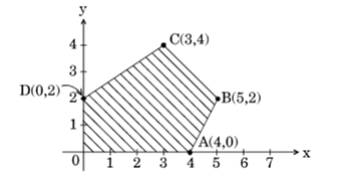
The corner points of the feasible region determined by the system of linear inequations are as shown below :
Image

Answer each of the following:
i. Let $z = 13x - 15y $ be the objective function. Find the maximum and minimum values of $z$ and also the
corresponding points at which the maximum and minimum values occur.
ii. Let $z = kx + y $ be the objective function. Find $k,$ if the value of $z$ at $A$ is same as the value of $z$ at $B$.
Let f be an invertible real function. Write $(f^{-1}of)(1) + (f^{-1}of)(2) + ..... + (f^{-1}of)(100)$.
A vector $\vec{\text{r}}$ is inclined to x-axis at 45º and y-axis at 60º. If $|\vec{\text{r}}|=8$ units, find $\vec{\text{r}}$.
Integrate the function in Exercise:$\tan^{-1}\sqrt{\frac{1-\text{x}}{1+\text{x}}}$
Prove that: $\tan^{-1}\big(\frac{1}{2}\big) + \tan^{-1}\big(\frac{1}{5}\big) + \tan^{-1}\big(\frac{1}{8}\big) =\frac{\pi}{4}.$
Show that the line through points $(1, -1, 2)$ and $(3, 4, -2)$ is perpendicular to the line throught the points $(0, 3, 2)$ and $(3, 5, 6)$.
If a random variable X follows a binomial distribution with mean 3 and variance 3/2, find P (X ≤ 5).
Evaluate the following integrals:
$\int\frac{\tan\text{x}}{\sec\text{x}+\tan\text{x}}\text{dx}$
Evaluate the following integrals:
$\int\limits^{\text{a}}_0\frac{\sqrt{\text{x}}}{\sqrt{\text{x}}+\sqrt{\text{a}-\text{x}}}\text{ dx}$