Question
Evaluate the following integrals:
$\int\frac{1}{(\text{x}^2+2\text{x}+10)^2}\text{ dx}$

Answer

Let $\int\frac{1}{(\text{x}^2+2\text{x}+10)^2}\text{ dx}$
$=\int\frac{1}{\big[(\text{x}+1)^2+3^2\big]}\text{ dx}$
Let $\text{x}+1=3\tan\theta$
On differentiating both sides, we get
$\text{dx}=3\sec^2\theta\text{ d}\theta$
$\therefore\ \text{I}=\int\frac{1}{\big[3^2\tan^2\theta+3^2\big]^2}3\sec^2\theta\text{ d}\theta$
$=\frac{1}{27}\int\frac{\sec^2\theta}{\sec^4\theta}\text{ d}\theta$
$=\frac{1}{27}\int\frac{1}{\sec^2\theta}\text{ d}\theta$
$=\frac{1}{27}\int\cos^2\theta\text{ d}\theta$
$=\frac{1}{54}\int(1+\cos2\theta)\text{d}\theta$
$=\frac{1}{54}\Big(\theta+\frac{\sin2\theta}{2}\Big)+\text{ C}$
$=\frac{1}{54}\Big(\theta+\frac{\tan\theta}{1+\tan^2\theta}\Big)+\text{C}$
$=\frac{1}{54}\begin{pmatrix}\tan^{-1}\frac{\text{x}+1}{3}+\frac{\tan\Big(\tan^{-1}\frac{\text{x}+1}{3}\Big)}{1+\tan^{2}\Big(\tan^{-1}\frac{\text{x}+1}{3}\Big)}\end{pmatrix}+\text{C}$
$=\frac{1}{54}\begin{pmatrix}\tan^{-1}\frac{\text{x}+1}{3}+\frac{\frac{\text{x}+1}{3}}{1+\Big(\frac{\text{x}+1}{3}\Big)^2}\end{pmatrix}+\text{C}$
$=\frac{1}{54}\Bigg(\tan^{-1}\frac{\text{x}+1}{3}+\frac{\frac{\text{x}+1}{3}}{\frac{\text{x}^2+2\text{x}+10}{9}}\Bigg)+\text{C}$
$=\frac{1}{54}\bigg(\tan^{-1}\frac{\text{x}+1}{3}+\frac{3(\text{x}+1)}{\text{x}^2+2\text{x}+10}\bigg)+\text{C}$

Need a full question paper?

Generate a complete, print-ready paper with questions like this in minutes — across 16+ boards, with answer keys.
Start Generating Free

Similar questions

For $\mathrm{A}, \mathrm{B}$ and $C$ the chances of being selected as the manager of a firm are in the ratio $4: 1: 2$ respectively. The respective probabilities for them to introduce a radical change in marketing strategy are $0.3,0.8$ and $0.5$. If the change does take place, find the probability that it is due to the appointment of $B$ or $C$ .
A balloon in the form of a right circular cone surmounted by a hemisphere, having a diametre equal to the height of the cone, is being inflated. How fast is its volume changing with respect to its total height h, when h = 9cm.
Show that $\text{f}(\text{x})=\tan^{-1}(\sin\text{x}+\cos\text{x})$ is a decreasing function on the interval $\Big(\frac{\pi}{4},\frac{\pi}{2}\Big).$
$\int\text{x}^2\sqrt{\text{x}+2}\text{ dx}$
Evaluate the following definite integrals:$\int_{0}^\limits{\frac{\pi}{2}}\sqrt{1+\sin\text{x}}\text{ dx}$
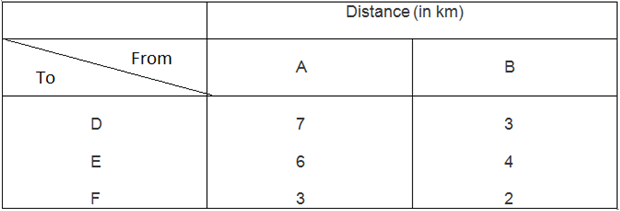
An oil company has two depots, A and B, with capacities of 7000 litres and 4000 litres respectively. The company is to supply oil to three petrol pumps, D, E, F whose requirements are 4500, 3000 and 3500 litres respectively. The distance (in km) between the depots and petrol pumps is given in the following table:

Assuming that the transportation cost per km is Rs. 1.00 per litre, how should the delivery be scheduled in order that the transportation cost is minimum?
Evaluate the following integrals:
$\int\frac{\text{x}^2-3\text{x}+1}{\text{x}^4+\text{x}^2+1}\ \text{dx}$
Compute the elements $a_{43}$ and $a_{22}$ of the matrix:
$\text{A}=\begin{bmatrix}0&1&0\\2&0&2\\0&3&2\\4&0&4\end{bmatrix}\begin{bmatrix}2&-1\\-3&2\\4&3\end{bmatrix}\begin{bmatrix}0&1&-1&2&-2\\3&-3&4&-4&0\end{bmatrix}$
Evaluate the following intregals:
$\int\frac{1}{\text{x}(\text{x}^\text{n}+1)}\text{ dx}$
Solve the following systems of linear equations by cramer's rule:
$x + y + z + w = 2,$
$x - 2y + 2z + 2w = -6,$
$2x + y - 2z + 2w = -5,$
$3x - y + 3z - 3w = -3$