Question
Evaluate the following integrals:
$\int(4\text{x}+1)\sqrt{\text{x}^2-\text{x}-2}\text{dx}$

Answer

Let $\text{I}=\int(4\text{x}+1)\sqrt{\text{x}^2-\text{x}-2}\text{dx}$
Let $4\text{x}+1=\lambda\frac{\text{d}}{\text{dx}}(\text{x}^2-\text{x}-2)+\mu$
$=\lambda(2\text{x}-1)+\mu$
Equating similar terms, we get,
$2\lambda=4\Rightarrow\lambda=2$
$-\lambda+\mu=1\Rightarrow\mu=3$
So,
$\text{I}=\int(2(2\text{x}-1)+3)\sqrt{\text{x}^2-\text{x}-2}\text{dx}$
$=2\int(2\text{x}-1)\sqrt{\text{x}^2-\text{x}-2}\text{dx}+3\int\sqrt{\text{x}^2-\text{x}-2}\text{dx}$
Let $\text{x}^2-\text{x}-2=\text{t}$
$(2\text{x}-1)\text{dx = dt}$
$\therefore\ \text{I}=2\int\sqrt{\text{t}}\text{dt}+3\int\sqrt{\Big(\text{x}-\frac{1}{2}\Big)^2-\Big(\frac{3}{2}\Big)^2}\text{dx}$
$\Rightarrow\text{I}=2\frac{\text{t}^{\frac{3}{2}}}{\frac{3}{2}}+3\begin{Bmatrix}\frac{\Big(\text{x}-\frac{1}{2}\Big)}{2}\sqrt{\text{x}^2-\text{x}-2}\\-\frac{9}{8}\log\Big|\Big(\text{x}-\frac{1}{2}\Big)+\sqrt{\text{x}^2-\text{x}-2}\Big|\end{Bmatrix}+\text{C}$
Hence,
$\Rightarrow\text{I}=\frac{4}{3}(\text{x}^2-\text{x}-2)^{\frac{3}{2}}+\frac{3}{4}(2\text{x}-1)\sqrt{\text{x}^2-\text{x}-2}\\-\frac{27}{8}\log\Big|\Big(\text{x}-\frac{1}{2}\Big)+\sqrt{\text{x}^2-\text{x}-2}\Big|+\text{C}$

Need a full question paper?

Generate a complete, print-ready paper with questions like this in minutes — across 16+ boards, with answer keys.
Start Generating Free

Similar questions

Evaluate the following intregals:
$\int\frac{\text{x}+2}{\sqrt{\text{x}^2+2\text{x}-1}}\text{dx}$
Without expanding, show that the values of the following determinant are zero:
$\begin{vmatrix}\frac{1}{\text{a}}&\text{a}^2&\text{bc}\\\frac{1}{\text{b}}&\text{b}^2&\text{ac}\\\frac{1}{\text{c}}&\text{c}^2&\text{ab} \end{vmatrix}$
By examining the chest X ray, the probability that TB is detected when a person is actually suffering is 0.99. The probability of an healthy person diagnosed to have TB is 0.001. In a certain city, 1 in 1000 people suffers from TB. A person is selected at random and is diagnosed to have TB. What is the probability that he actually has TB?
Find the distance of the point P(3, 4, 4) from the point, where the line joining the points A(3, -4, -5) and B(2, -3, 1) intersects the plane 2x + y + z = 7.
Evaluate the following definite integrals:
$\int\limits_{\text{e}}^{\text{e}^2}\Big\{\frac{1}{\log\text{x}}-\frac{1}{(\log\text{x})^2}\Big\}\text{dx}$
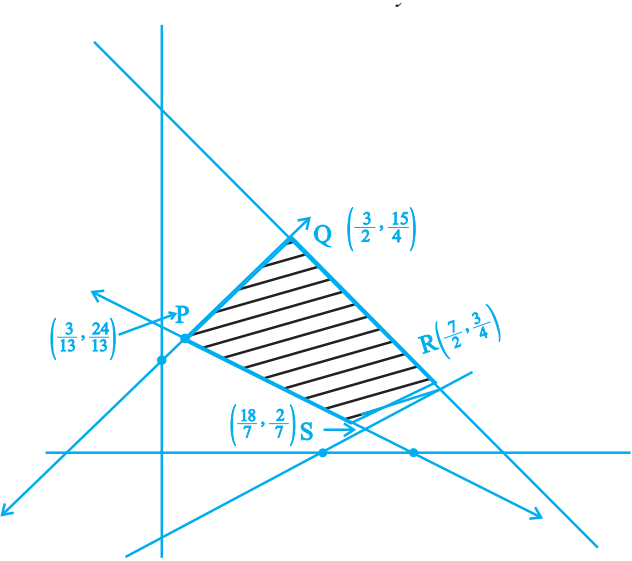
In the feasible region (shaded) for a LPP is shown. Determine the maximum and minimum value of Z = x + 2y.
Find the area bounded by the curve x = 4y and the line x = 4y - 2.
Solve the following LPP using graphical method
$
\begin{array}{cc}
\text { Minimize } & z=3 x+5 y \\
\text { constraints } & x+3 y \geq 3 \\
& x+y \geq 2 \\
& x \geq 0, y \geq 0
\end{array}
$
A cottage industry manufactures pedestal lamps and wooden shades, each requiring the use of grinding/cutting machine and sprayer. It takes 2 hours on the grinding/cutting machine and 3 hours on the sprayer to manufacture a pedestal lamp while it takes 1 hour on the grinding/cutting machine and 2 hours on the sprayer to manufacture a shade. On any day, the sprayer is available for at most 20 hours and the grinding/cutting machine for at most 12 hours. The profit from the sale of a lamp is Rs. 5.00 and a shade is Rs. 3.00. Assuming that the manufacturer can sell all the lamps and shades that he produces, how should he schedule his daily production in order to maximise his profit?
Find the distance between the point (7, 2, 4) and the plane determined by the points A(2, 5, -3), B(-2, -3, 5) nad C(5, 3, -3).