Question
Evaluate the following integrals:
$\int\limits^{\frac{\pi}{6}}_{0}\cos^{-3}2\theta\sin2\theta\text{ d}\theta$

Answer

We have,
$\int^\limits{\frac{\pi}{6}}_{0}\cos^{-3}2\theta\sin2\theta\text{ d}\theta$
$=\int^\limits{\frac{\pi}{6}}_{0}\frac{\sin2\theta}{\cos^32\theta}\text{ d}\theta$
$=\int^\limits{\frac{\pi}{6}}_{0}\tan2\theta\cdot\sec^22\theta\text{ d}\theta$
Let $\tan2\theta=\text{t}$
Differentiating w.r.t. x, we get
$2\sec^22\theta\text{d}\theta=\text{dt}$
Now, $\theta=0\Rightarrow\text{t}=0$
$\theta=\frac{\pi}{6}\Rightarrow\text{t}=\sqrt{3}$
$\therefore\ \int^\limits{\frac{\pi}{6}}_{0}\tan2\theta\cdot\sec^22\theta\text{ d}\theta=\frac{1}{2}\int^\limits{\sqrt{3}}_0\text{t dt}=\frac{1}{2}\Big[\frac{\text{t}^2}{2}\Big]^{\sqrt{\text{3}}}_0$
$=\frac{3}{4}$

Need a full question paper?

Generate a complete, print-ready paper with questions like this in minutes — across 16+ boards, with answer keys.
Start Generating Free

Similar questions

Evaluate the following integrals:
$\int\limits^{\frac{\pi}{3}}_{\frac{\pi}{6}}\frac{\sqrt{\sin\text{x}}}{\sqrt{\sin\text{x}}+\sqrt{\cos\text{x}}}\text{ dx}$
Tangent to the circle $\text{x}^{2} + \text{y}^{2} = 4$ at any point on it in the first quadrant makes intercepts OA and OB on x and y axes respectively, O being the centre of the circle. Find the minimum value of (OA + OB).
Evaluate the following integrals:
$\int\limits^{\text{a}}_{-\text{a}}\sqrt{\frac{\text{a}-\text{x}}{\text{a}+\text{x}}}\text{ dx}$
If $\text{y}\sin(\text{x}^\text{x}),$ prove that $\frac{\text{dy}}{\text{dx}}=\cos(\text{x}^\text{x})\times\text{x}^\text{x}(1+\log\text{x})$
Show that the vectors $\overrightarrow{\text{a}},\overrightarrow{\text{b}} \text{and}{\overrightarrow{\text{c}}}$ are coplanar $\overrightarrow{\text{a}} +\overrightarrow{\text{b}}, \overrightarrow{\text{b}}+\overrightarrow{\text{c}}\text{and} \overrightarrow{\text{c}} + \overrightarrow{\text{a}}$ are coplanar.
Find the equation of the tangent line to the curve y = x2 - 2x + 7 which is parallel to the line 2x - y + 9 = 0
$\begin{vmatrix}0&\text{b}^2\text{a}&\text{c}^2\text{a}\\\text{a}^2\text{b}&0&\text{c}^2\text{b}\\\text{a}^2\text{c}&\text{b}^2\text{c}&0\end{vmatrix}=2\text{a}^3\text{b}^3\text{c}^3$
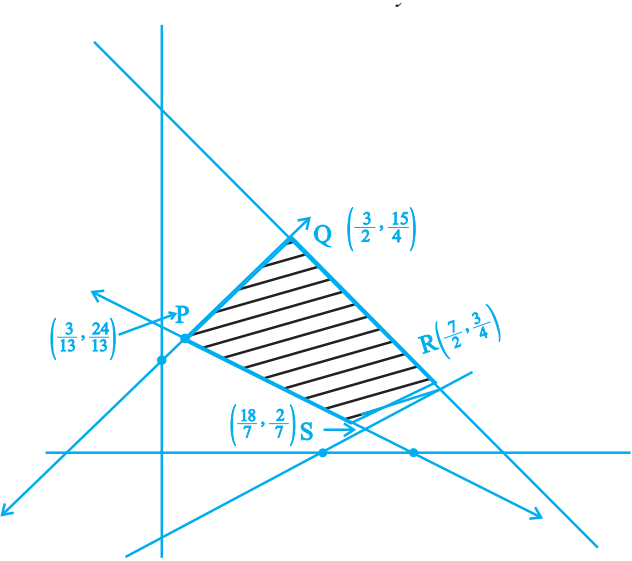
In the feasible region (shaded) for a LPP is shown. Determine the maximum and minimum value of Z = x + 2y.
Solve the matrix equation $\begin{bmatrix}5 & 4 \\1 & 1 \end{bmatrix}\text{X}=\begin{bmatrix}1 & -2 \\1 & 3 \end{bmatrix},$ where X is a 2 × 2 matrix.
If $\tan(\text{x}+\text{y})+\tan(\text{x}+\text{y})=1,$ find $\frac{\text{dy}}{\text{dx}}$