Question
Evaluate the following integrals:
$\int\limits^\text{b}_{\text{a}}\frac{\text{f(x)}}{\text{f(x)}+\text{f}(\text{a}+\text{b}-\text{x})}\text{ dx}$
Answer

Let $\text{I}=\int\limits^\text{b}_{\text{a}}\frac{\text{f(x)}}{\text{f(x)}+\text{f}(\text{a}+\text{b}-\text{x})}\text{ dx}\ ....(\text{i})$
$=\int\limits^\text{b}_{\text{a}}\frac{\text{f}(\text{a}+\text{b}-\text{x})}{\text{f}(\text{a}+\text{b}-\text{x})+\text{f}(\text{a}+\text{b}-\text{a}-\text{b}+\text{x})}\text{ dx}$
$=\int\limits^\text{b}_{\text{a}}\frac{\text{f}(\text{a}+\text{b}-\text{x})}{\text{f}(\text{a}+\text{b}-\text{x})+\text{f(x)}}\text{ dx}$
$\therefore\ \text{I}=\int\limits^\text{b}_{\text{a}}\frac{\text{f}(\text{a}+\text{b}-\text{x})}{\text{f(x)}+\text{f}(\text{a}+\text{b}-\text{x})}\text{ dx}\ ...(\text{ii})$
Adding (i) and (ii) we get
$2\text{I}=\int\limits^\text{b}_{\text{a}}\bigg[\frac{\text{f(x)}}{\text{f(x)}+\text{f}(\text{a}+\text{b}-\text{x})}+\frac{\text{f}(\text{a}+\text{b}-\text{x})}{\text{f(x)}+\text{f}(\text{a}+\text{b}-\text{x})}\bigg]\text{dx}$
$=\int\limits^\text{b}_{\text{a}}\frac{\text{f(x)}+\text{f}(\text{a}+\text{b}-\text{x})}{\text{f(x)}+\text{f}(\text{a}+\text{b}-\text{x})}\text{ dx}$
$=\big[\text{x}\big]^{\text{b}}_\text{a}$
$=\text{b}-\text{a}$
Hence, $\text{I}=\frac{\text{b}-\text{a}}{2}$

Need a full question paper?

Generate a complete, print-ready paper with questions like this in minutes — across 16+ boards, with answer keys.

Start Generating Free

Similar questions

Write the value of $\tan^{-1}\frac{\text{a}}{\text{b}}-\tan^{-1}\Big(\frac{\text{a}-\text{b}}{\text{a}+\text{b}}\Big).$
A bag contains $1$ white and $6$ red balls, and a second bag contains $4$ white and $3$ red balls. One of the bags is picked up at random and a ball is randomly drawn from it, and is found to be white in colour. Find the probability that the drawn ball was from the first bag.
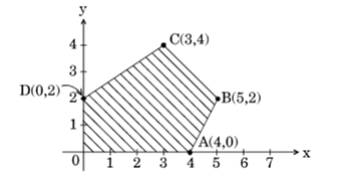
The corner points of the feasible region determined by the system of linear inequations are as shown below :
Image

Answer each of the following:
i. Let $z = 13x - 15y $ be the objective function. Find the maximum and minimum values of $z$ and also the
corresponding points at which the maximum and minimum values occur.
ii. Let $z = kx + y $ be the objective function. Find $k,$ if the value of $z$ at $A$ is same as the value of $z$ at $B$.
Find the values of p so that the lines $\frac{{1 - x}}{3} = \frac{{7y - 14}}{{2p}} = \frac{{z - 3}}{2}$ and $\frac{{7 - 7x}}{{3p}} = \frac{{y - 5}}{1} = \frac{{6 - z}}{5}$ are at right angles.
Evaluate the following integrals:
$\int\frac{1+\cos\text{x}}{(\text{x}+\sin\text{x})^3}\text{dx}$
Evaluate the following integrals:
$\int\frac{1}{(\text{x}-1)\sqrt{\text{x}^2+1}}\text{ dx}$
Integrate the function: $\frac{e^{2 x}~-1}{e^{2 x}~+1}$
Write the following in the simplest form:
$\tan^{-1}\sqrt{\frac{\text{a}-\text{x}}{\text{a}+\text{x}}},-\text{a}<\text{x}<\text{a}$
$\text{If y}=5\cos\text{x}-3\sin\text{x},\text{ prove that }\frac{\text{d}^2\text{y}}{\text{dx}^2}+\text{y}=0$
Ten eggs are drawn successively, with replacement, from a lot containing 10% defective eggs. Find the probability that there is at least one defective egg.