Question
Evaluate the following integrals:
$\int\limits^\pi_0\Big(\frac{\text{x}}{1+\sin^2\text{x}}+\cos^7\text{x}\Big)\text{dx}$

Answer

Let $\text{I}=\int\limits^\pi_0\Big(\frac{\text{x}}{1+\sin^2\text{x}}+\cos^7\text{x}\Big)\text{dx}\ ....(\text{i})$
Then,
$\text{I}=\int\limits^\pi_0\Big(\frac{\pi-\text{x}}{1+\sin^2(\pi-\text{x})}+\cos^7(\pi-\text{x})\Big)\text{dx}$
$=\int\limits^\pi_0\Big(\frac{\pi-\text{x}}{1+\sin^2\text{x}}+\cos^7\text{x}\Big)\text{dx}\ ...(\text{ii})$
Adding (i) and (ii) we get
$2\text{I}=\int\limits^\pi_0\Big(\frac{\text{x}}{1+\sin^2\text{x}}+\cos^7\text{x}+\frac{\pi-\text{x}}{1+\sin^2\text{x}}-\cos^7\text{x}\Big)\text{dx}$
$\Rightarrow2\text{I}=\pi\int\limits^\pi_0\frac{1}{1+\sin^2\text{x}}\text{ dx}$
Dividing the numerator and denominator by $\cos^2\text{x},$ we get
$2\text{I}=\pi\int\limits^\pi_0\frac{\sec^2\text{x}}{\sec^2\text{x}+\tan^2\text{x}}\text{ dx}$
$\Rightarrow2\text{I}=\pi\int\limits^\pi_0\frac{\sec^2\text{x}}{1+2\tan^2\text{x}}\text{ dx}$
$\Rightarrow2\text{I}=2\pi\int\limits^\pi_0\frac{\sec^2\text{x}}{1+2\tan^2\text{x}}\text{ dx}$ $\begin{bmatrix}\int\limits^{2\text{a}}_0\text{f(x)}\text{dx}=\begin{cases}\int\limits^{2\text{a}}_0\text{f(x)}\text{dx},&\text{if }\text{f}(2\text{a}-\text{x})=\text{f(x)}\\0,&\text{if }\text{f}(2\text{a}-\text{x})=\text{f(x)}\end{cases}\end{bmatrix}$
Put $\tan\text{x}=\text{z}$
Then $\sec^2\text{x dx}=\text{dz}$
When $\text{x}\rightarrow0,\text{ z}\rightarrow0$
When $\text{x}\rightarrow\frac{\pi}{2},\text{ z}\rightarrow\infty$
$\therefore\ 2\text{I}=2\pi\int\limits^{\infty}_0\frac{\text{dz}}{1+\big(\sqrt{2}\text{z}\big)^2}$
$\Rightarrow2\text{I}=2\pi\times\bigg[\frac{\tan^{-1}\sqrt{2}\text{z}}{\sqrt{2}}\bigg]^{\infty}_0$
$\Rightarrow\text{I}=\frac{\pi}{\sqrt{2}}\Big(\tan^{-1}\infty-\tan^{-1}0\Big)$
$\Rightarrow\text{I}=\frac{\pi}{\sqrt{2}}\times\Big(\frac{\pi}{2}-0\Big)$
$\Rightarrow\text{I}=\frac{\pi^2}{2\sqrt{2}}$

Need a full question paper?

Generate a complete, print-ready paper with questions like this in minutes — across 16+ boards, with answer keys.
Start Generating Free

Similar questions

It is given that the Rolle's theorem holds for the function f(x) = x3 + bx2 + cx, $\text{x}\in[1,2]$ at the point $\text{x}=\frac{4}{3},$ the values of b and c.
Let L be the set of all lines in XY-plane and R be the relation in L defined as R = {(L1, L2): L1 is parallel to L2}. Show that R is an equivalence relation. Find the set of all lines related to the line y = 2x + 4.
Find $\frac{\text{dy}}{\text{dx}},$ when
$\text{x}=\text{ae}^{\theta}(\sin\theta-\cos\theta),\text{y}=\text{ae}^\theta(\sin\theta+\cos\theta)$
Evaluate the following determinant:
$\begin{vmatrix}6&-3&2\\2&-1&2\\-10&5&2 \end{vmatrix}$
If f(x) is a continuous function defind on [-a, a], then prove that:
$\int\limits^{\text{a}}_{-\text{a}}\text{f(x)}\text{dx}=\int\limits^{\text{a}}_0\big\{\text{f(x)}+\text{f}(-\text{x})\big\}\text{dx}$ 
Show that the points whose position vectors are as given below are collinear:
$2\hat{\text{i}}+\hat{\text{j}}-\hat{\text{k}},\ 3\hat{\text{i}}-2\hat{\text{j}}+\hat{\text{k}}$ and $\hat{\text{i}}+4\hat{\text{j}}-3\hat{\text{k}}$
if $\text{A}=\begin{bmatrix}2 & -3&5 \\3 & 2&-4\\1&1&-2 \end{bmatrix},$ find A-1. Use it to solve the system of equations
2x - 3y + 5z = 11
3x + 2y – 4z = -5
x + y - 2z = -3.
Find the intervals in which the following functions are increasing or decreasing.
f(x) = 3x4 - 4x3 - 12x2 + 5
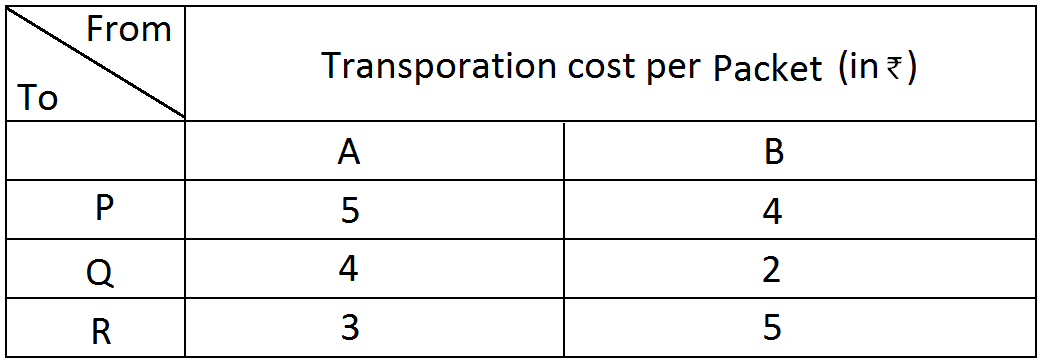
A medical company has factories at two places, A and B. From these places, supply is made to each of its three agencies situated at P, Q and R. The monthly requirements of the agencies are respectively 40, 40 and 50 packets of the medicines, while the production capacity of the factories, A and B, are 60 and 70 packets respectively. The transportation cost per packet from the factories to the agencies are given below:

How many packets from each factory be transported to each agency so that the cost of transportation is minimum? Also find the minimum cost?

If $\text{A}=\begin{bmatrix}2&-1\\3&2 \end{bmatrix} $ and $\text{B}=\begin{bmatrix}0&4\\-1&7\end{bmatrix} ,$ find 3A2 - 2B + l