Question
Evaluate the following integrals:
$\int\limits^{{\pi}}_0\cos^5\text{x dx}$

Answer

Let $\text{I}=\int\limits^{{\pi}}_0\cos^5\text{x dx}$
$=\int\limits^{{\pi}}_0\cos\text{x}\big(\cos^2\text{x}\big)^2\text{dx}$
$=\int\limits^{{\pi}}_0\cos\text{x}\big(1-\sin^2\text{x}\big)^2\text{dx}$
Let $\sin\text{x}=\text{t},$ then $\cos\text{x dx}=\text{dt}$
When, $\text{x}\rightarrow0;\text{ t}\rightarrow0$ and $\text{x}\rightarrow\pi;\text{ t}\rightarrow0$
Therefore,
$\text{I}=\int\limits^0_0\big(1-\text{t}^2\big)^2\text{dt}$
$\text{I}=0$

Need a full question paper?

Generate a complete, print-ready paper with questions like this in minutes — across 16+ boards, with answer keys.
Start Generating Free

Similar questions

If $\vec{\text{a}}=4\hat{\text{i}}+3\hat{\text{j}}+\hat{\text{k}}$ and $\vec{\text{b}}=\hat{\text{i}}-2\hat{\text{k}},$ then find $\big|2\hat{\text{b}}\times\vec{\text{a}}\big|.$
Find the angle between two vectors $\hat i - 2\hat j + 3\hat k$ and $3\hat i - 2\hat j + \hat k\;$
Show that $\text{AB}\neq\text{BA}$ in the following cases:
$\text{A}=\begin{bmatrix}-1&1&0\\0&-1&1\\2&3&4\end{bmatrix}$ and $\text{B}=\begin{bmatrix}1&2&3\\0&1&0\\1&1&0\end{bmatrix}$
Evaluate the following integrals:
$\int\text{e}^{\text{x}}(\cos\text{x}-\sin\text{x})\text{dx}$
show that  $\text{f}\text{(x)}=\begin{cases}\frac{\text{x}-|\text{x}|}{2}, & \text{when} \text{ x}\neq 0\\2, & \text{when}\text{ x} = 0\end{cases}$ is discontinuous at x = 0.
By using the properties of definite integrals, evaluate the integral $\int\limits_0^{\frac{\pi }{2}} {\frac{{\sin x - \cos x}}{{1 + \sin x\cos x}}} dx$
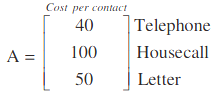
In a legislative assembly election, a political group hired a public relations firm to promote its candidate in three ways: telephone, house calls, and letters. The cost per contact (in paise) is given in matrix A as

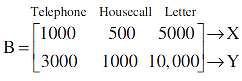
The number of contacts of each type made in two cities X and Y is given by

Find the total amount spent by the group in the two cities X and Y.
If x and y are connected parametrically by the equation $x = a\left( {\cos \theta + \theta \sin \theta } \right),$ $y = a\left( {\sin \theta - \theta \cos \theta } \right)$, without eliminating the parameter, find $\frac{{dy}}{{dx}}$.
In answering a question on a multiple choice test a student either knows the answer or guesses. Let $\frac{3}{4}$ be the probability that he knows the answer and $\frac{1}{4}$ be the probability that he guesses. Assuming that a student who guesses at the answer will be correct with probability $\frac{1}{4}$. What is the probability that a student knows the answer given that he answered it correctly?
Write a value of $\int\text{e}^{\text{x}}\sec\text{x}(1+\tan\text{x})\text{dx}$