Question
Evaluate the following integrals:
$\int\sec\text{x}.\text{log} (\sec\text{x}+\tan\text{x})\text{dx}$

Answer

$\int\sec\text{x}.\text{log} (\sec\text{x}+\tan\text{x})\text{dx}$
$\text{Let }\text{ log}(\sec\text{x}+ \tan\text{x})=\text{t}$
$\Rightarrow \frac{(\sec\text{x} \tan\text{x}+\sec^{2}\text{x})} {(\sec\text{x} +\tan\text{x})}=\frac{\text{dt}}{\text{dx}}$
$\Rightarrow \frac{\sec\text{x} (\sec\text{x}+\tan\text{x})} {(\sec\text{x} +\tan\text{x})}\text{dx}=\text{dt}$
$\text{Now},\int\sec \text{x}.\text{log}(\sec\text{x}+\tan\text{x})\text{dx}$
$=\int \text{t}.\text{dt}$
$=\frac{\text{t}^{2}}{2}+\text{C}$
$=\frac{[\text{log}(\sec\text{x}+\tan\text{x})]^2}{2}+\text{C}$

Need a full question paper?

Generate a complete, print-ready paper with questions like this in minutes — across 16+ boards, with answer keys.
Start Generating Free

Similar questions

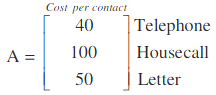
In a legislative assembly election, a political group hired a public relations firm to promote its candidate in three ways: telephone, house calls, and letters. The cost per contact (in paise) is given in matrix A as

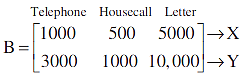
The number of contacts of each type made in two cities X and Y is given by

Find the total amount spent by the group in the two cities X and Y.
Define $\vec{\text{a}}\times\vec{\text{b}}$ and prove that $\big|\vec{\text{a}}\times\vec{\text{b}}\big|=\big(\vec{\text{a}}.\vec{\text{b}}\big)\tan\theta,$ where $\theta$ is the angle between $\vec{\text{a}}$ and $\vec{\text{b}}.$
Show that the following point are coplanar:
(0, -1, 0), (2, 1, -1), (1, 1, 1) and (3, 3, 0)
If $​​\vec{\text{a}}+​​\vec{\text{b}}​​+\vec{\text{c}}=\vec{0,}$ show that the angle $\theta$ between the vectors $​​\vec{\text{b}}$ and $\vec{\text{c}}$ is given by 

$\cos\theta=\frac{|\vec{\text{a}}|^2-\big|\vec{\text{b}}\big|^2-|\vec{\text{c}}|^2}{2\big|\vec{\text{b}}\big||\vec{\text{c}}|}.$
Differentiate the following w.r.t. x:
$\sin^{-1}\Big(\frac{1}{\sqrt{\text{x}+1}}\Big)$
Differentiate the following functions with respect to x:
$\tan^2\text{x}$
Find the value of $\lambda$ so that the following vectors are coplanar:
$\vec{\text{a}}=\hat{\text{i}}-\hat{\text{j}}+\hat{\text{k}},\vec{\text{b}}=2\hat{\text{i}}+\hat{\text{j}}-\hat{\text{k}},\vec{\text{c}}=\lambda\hat{\text{i}}-\hat{\text{j}}+\lambda\hat{\text{k}}$
For each of the differential equations in find the general solution:
$\frac{\text{dy}}{\text{dx}}=\sqrt{4-\text{y}^2}(-2<\text{y}<2)$
Find the particular solution of the differential equation $\left( 1 + x ^ { 2 } \right) \frac { d y } { d x } + 2 x y = \frac { 1 } { 1 + x ^ { 2 } }$, given that y = 0 when x = 1.
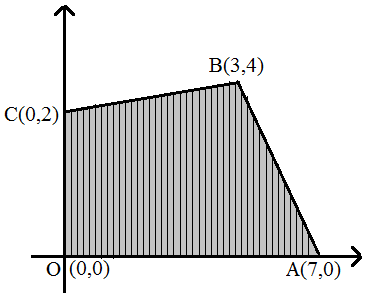
Feasible region (shaded) for a LPP is shown in Maximise Z = 5x + 7y.