Question
Evaluate the following integrals:
$\int\sqrt{\text{x}}\Big(\text{x}^3-\frac{2}{\text{x}}\Big)\text{dx}$

Answer

$\int\sqrt{\text{x}}\Big(\text{x}^3-\frac{2}{\text{x}}\Big)\text{dx}$
$=\int\Big(\text{x}^{\frac{7}{2}}-\frac{2}{\sqrt{\text{x}}}\Big)\text{dx}$
$=\int\Big(\text{x}^{\frac{7}{2}}-{2}{\text{x}^{-\frac{1}{2}}}\Big)\text{dx}$
$=\frac{\text{x}^{\frac{7}{2}+1}}{\frac{7}{2}+1}-2\frac{\text{x}^{-\frac{1}{2}+1}}{-\frac{1}{2}+1}+\text{C}$
$=\frac{2}{9}\text{x}^{\frac{9}{2}}-4\text{x}^{\frac{1}{2}}+\text{C}$
$=\frac{2}{9}\text{x}^{\frac{9}{2}}-4\sqrt{\text{x}}+\text{C}$

Need a full question paper?

Generate a complete, print-ready paper with questions like this in minutes — across 16+ boards, with answer keys.
Start Generating Free

Similar questions

If the line has direction ratios 2, -1, -2 determine its direction Cosines.
$\text{Let}\ \vec{\text{a}}=\hat{\text{i}}+4\hat{\text{j}}+2\hat{\text{k}},\ \vec{\text{b}}=3\hat{\text{i}}-2\hat{\text{j}}+7\hat{\text{k}}$ and $ \vec{\text{c}}=2\hat{\text{i}}-\hat{\text{j}}+4\hat{\text{k}}.$ Find a vector $\vec{\text{d}}$ which is perpendicular to both $\vec{\text{a}}\ \text{and}\ \vec{\text{b}},\ \text{and}\ \vec{\text{c}}\cdot\vec{\text{d}}=15.$
Evaluate the following integrals:
$\int\frac{1-\cos\text{x}}{1+\cos\text{x}}\text{dx}$
Let n be a fixed positive integer. Define a relation R in Z as follows $\forall\ \text{a},\ \text{b}\in\text{Z},$ aRb if and only if a - b is divisible by n. Show that R is an equivalance relation.
Write a value of $\int\text{e}^{\text{x}}\Big(\frac{1}{\text{x}}-\frac{1}{\text{x}^2}\Big)\text{dx}$
Find an anti derivative $($or integral$)$ of the function by the method of inspection $\sin 2x - 4e^{3x}$
If $\vec{\text{a}}$ are $\vec{\text{b}}$ are unit vectors, then find the between $\vec{\text{a}}$ and $\vec{\text{b}},$ given that $\big(\sqrt{3}\vec{\text{a}}-​\vec{\text{b}}\big)$ is aunit vector.
Evaluate the following integrals:
$\int\limits^{2\pi}_0\cos^{-1}(\cos\text{x})\text{dx}$
A bag contains 5 white, 7 red and 3 black balls. If three balls are drawn one by one without replacement, find the probability that none is red.
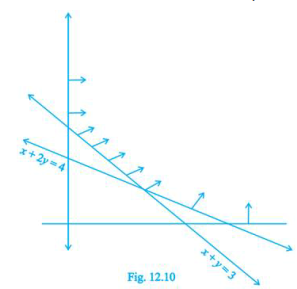
The feasible region for a LPP is shown in Figure. Evaluate Z = 4x + y at each of the corner points of this region. Find the minimum value of Z, if it exists.
Image