Question
Evaluate the following integrals:$\int\frac{(\text{x}-1)^2}{\text{x}^2+2\text{x}+2}\text{ dx}$
Answer

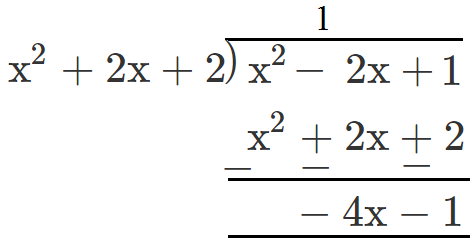
Let $\int\frac{(\text{x}-1)^2}{\text{x}^2+2\text{x}+2}\text{ dx}$ $=\int\Big(\frac{\text{x}^2-2\text{x}+1}{\text{x}^2-2\text{x}+2}\Big)\text{dx}$ Here,
Therefore,
$\frac{\text{x}^2-2\text{x}+1}{\text{x}^2+2\text{x}+2}=1-\frac{(4\text{x}+1)}{\text{x}^2+2\text{x}+2}\ ....(1)$ Let $4\text{x}+1=\text{A}\frac{\text{d}}{\text{dx}}\big(\text{x}^2+2\text{x}+2\big)+\text{B}$ $4\text{x}+1=\text{A}(2\text{x}+2)+\text{B}$ $4\text{x}+1=(2\text{A})\text{x}+2\text{A}+\text{B}$ Equating Cofficients of like terms $2\text{A}=4$ $\text{A}=2$ $2\text{A}+\text{B}=1$ $2\times2+\text{B}=1$ $\text{B}=-3$ $\int\Big(\frac{\text{x}^2-2\text{x}+1}{\text{x}^2-2\text{x}+2}\Big)\text{dx}$ $=\int\text{dx}-2\int\frac{(2\text{x}+2)}{\text{x}^2+2\text{x}+2}\text{ dx}+3\int\frac{\text{ dx}}{\text{x}^2+2\text{x}+2}$ $=\int\text{dx}-2\int\frac{(2\text{x}+2)}{\text{x}^2+2\text{x}+2}\text{ dx}+3\int\frac{\text{dx}}{(\text{x}+1)^2+1^2}$ $=\text{x}-2\log\big|\text{x}^2+2\text{x}+2\big|+\frac{3}{1}\tan^{-1}\Big(\frac{\text{x}+1}{1}\Big)+\text{C}$ $=\text{x}-2\log\big|\text{x}^2+2\text{x}+2\big|+3\tan^{-1}(\text{x}+1)+\text{C}$

Need a full question paper?

Generate a complete, print-ready paper with questions like this in minutes — across 16+ boards, with answer keys.

Start Generating Free

Similar questions

Evaluate the following integrals:$\int(\log\text{x})^2\cdot\text{x dx}$
Using integration, find the area of the region: $\left\{(\text{x},\text{y}) : |\text{x}-1|<\text{y}<\sqrt{5-\text{x}^{2}}\right\}$.
Solve the following differential equation:$\frac{\text{dy}}{\text{dx}}+2\text{y}=6\text{e}^{\text{x}}$
Find the inverse of the following matrices by using elementry row transformation:$\begin{bmatrix} 2 & 0 & -1 \\ 5 & 1 & 0 \\ 0 & 1 & 3 \end{bmatrix}$
Using integration, find the area of the following region:
$\Big\{(\text{x},\text{y}):\frac{\text{x}^2}{9}+\frac{\text{y}^2}{4}\leq1\leq\frac{\text{x}}{3}+\frac{\text{y}}{2}\Big\}$
The probability distribution of a random variable x is given as under:
$\text{P}(\text{X}=\text{x})=\begin{cases}\text{k}\text{x}^2 & \text{for}\text{ x}= 1,2,3\\2\text{kx} & \text{for}\text{ x } =4,5,6\\0&\text{otherwise} \end{cases}$
where k is a constant. Calculate
  1. $\text{E}(\text{X})$
  2. $\text{E}(3\text{X}^2)$
  3. $\text{P}(\text{X}\geq4)$
Prove that:
$\begin{vmatrix}-\text{bc}&\text{b}^2+\text{bc}&\text{c}^2+\text{bc}\\\text{a}^2+\text{ac}&-\text{ac}&\text{c}^2+\text{ac}\\\text{a}^2+\text{ab}&\text{b}^2+\text{ab}&-\text{ab}\end{vmatrix}$
$=(\text{ab}+\text{bc}+\text{ca})^3$
Solve the following determinant equations:
$\begin{vmatrix}15-2\text{x}&11-3\text{x}&7-\text{x}\\11&17&14\\10&16&13\end{vmatrix}=0$
Differentiate the following functions with respect to x:
$\sin^{-1}\Big\{\frac{\text{x}}{\sqrt{\text{x}^2+\text{a}^2}}\Big\}$
A manufacturer makes two products A and B. Product A sells at Rs. 200 each and takes 1/2 hour to make. Product B sells at Rs. 300 each and takes 1 hour to make. There is a permanent order for 14 of product A and 16 of product B. A working week consists of 40 hours of production and weekly turnover must not be less than Rs 10000. If the profit on each of product A is Rs. 20 and on product B is Rs. 30, then how many of each should be produced so that the profit is maximum. Also, find the maximum profit.