Question
Evaluate the following integrals:$\int\frac{(\text{x}-1)^2}{\text{x}^2+2\text{x}+2}\text{ dx}$
Answer

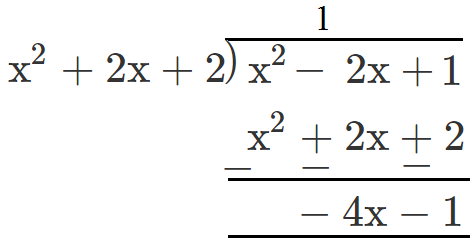
Let $\int\frac{(\text{x}-1)^2}{\text{x}^2+2\text{x}+2}\text{ dx}$ $=\int\Big(\frac{\text{x}^2-2\text{x}+1}{\text{x}^2-2\text{x}+2}\Big)\text{dx}$ Here,
Therefore,
$\frac{\text{x}^2-2\text{x}+1}{\text{x}^2+2\text{x}+2}=1-\frac{(4\text{x}+1)}{\text{x}^2+2\text{x}+2}\ ....(1)$ Let $4\text{x}+1=\text{A}\frac{\text{d}}{\text{dx}}\big(\text{x}^2+2\text{x}+2\big)+\text{B}$ $4\text{x}+1=\text{A}(2\text{x}+2)+\text{B}$ $4\text{x}+1=(2\text{A})\text{x}+2\text{A}+\text{B}$ Equating Cofficients of like terms $2\text{A}=4$ $\text{A}=2$ $2\text{A}+\text{B}=1$ $2\times2+\text{B}=1$ $\text{B}=-3$ $\int\Big(\frac{\text{x}^2-2\text{x}+1}{\text{x}^2-2\text{x}+2}\Big)\text{dx}$ $=\int\text{dx}-2\int\frac{(2\text{x}+2)}{\text{x}^2+2\text{x}+2}\text{ dx}+3\int\frac{\text{ dx}}{\text{x}^2+2\text{x}+2}$ $=\int\text{dx}-2\int\frac{(2\text{x}+2)}{\text{x}^2+2\text{x}+2}\text{ dx}+3\int\frac{\text{dx}}{(\text{x}+1)^2+1^2}$ $=\text{x}-2\log\big|\text{x}^2+2\text{x}+2\big|+\frac{3}{1}\tan^{-1}\Big(\frac{\text{x}+1}{1}\Big)+\text{C}$ $=\text{x}-2\log\big|\text{x}^2+2\text{x}+2\big|+3\tan^{-1}(\text{x}+1)+\text{C}$

Need a full question paper?

Generate a complete, print-ready paper with questions like this in minutes — across 16+ boards, with answer keys.

Start Generating Free

Similar questions

Express the vector $\vec{\text{a}}=5\hat{\text{i}}-2\hat{\text{j}}+5\hat{\text{k}}$ as the sum of two vectors such that one is parallel to the vector $\vec{\text{b}}=3\hat{\text{i}}+\hat{\text{k}}$ and other is perpendicular to $\vec{\text{b}}.$
Find the condition for the following set of curves to intersect orthogonally
$\frac{\text{x}^2}{\text{a}^2}-\frac{\text{y}^2}{\text{b}^2}=1\text{ and }\frac{\text{x}^2}{\text{A}^2}-\frac{\text{y}^2}{\text{B}^2}=1$
Prove the following identities:
$\begin{vmatrix}\text{a}^3&2&\text{a}\\\text{b}^3&2&\text{b}\\\text{c}^3&2&\text{c}\end{vmatrix}$
$=2(\text{a}-\text{b})(\text{b}-\text{c})(\text{c}-\text{a})(\text{a}+\text{b}+\text{c})$
Let $\text{F}(\alpha)=\begin{bmatrix}\cos\alpha & -\sin\alpha & 0 \\ \sin\alpha & \cos\alpha & 0 \\ 0 & 0 & 1\end{bmatrix}$ and$\text{G}(\beta)=\begin{bmatrix} \cos\beta & 0 & \sin\beta \\ 0 & 1 & 0 \\ -\sin\beta & 0 & \cos\beta \end{bmatrix}$
Show that$\big[\text{F}(\alpha)\big]^{-1}=\text{F}(-\alpha)$
Find the mean and variance of the number of tails in three tosses of a coin.
Find the points of discontinuity, if any of the following function:
$\text{f(x)}=\begin{cases}\frac{\sin\text{x}}{\text{x}},&\text{if }\text{ x}<0\\2\text{x}+3,&\text{ x}\geq0\end{cases}$
Find the feasible solution of the following inequations graphically.x + 4y ≤ 24, 3x + y ≤ 21, x + y ≤ 9, x ≥ 0, y ≥ 0.
Solve the following system of homogeneous linear equations:
x + y - 2z = 0,
2x + y - 3z = 0,
5x + 4y - 9z = 0
Find the angle of intersecting of the following curves:
$\text{x}^2+4\text{y}^2=8\text{ and }\text{a}^2-2\text{y}^2=2$
Let $d_1, d_2, d_3$ be three mutually exclusive diseases. Let $S$ be the set of observable symptoms of these diseases. $A$ doctor has the following information from a random sample of 5000 patients: 1800 had disease $\mathrm{d}_1, 2100$ has disease $\mathrm{d}_2$, and others had disease $\mathrm{d}_3 .1500$ patients with disease $\mathrm{d}_1, 1200$ patients with disease $\mathrm{d}_2$, and 900 patients with disease $d_3$ showed the symptom. Which of the diseases is the patient most likely to have?