Question
Evaluate the following integrals:$\int\frac{\text{x}+1}{\text{x}^2+\text{x}+3}\text{ dx}$

Answer

Let $\text{I}=\int\frac{\text{x}}{\text{x}^2+\text{x}+3}\text{ dx}$
Let $\text{x}=\lambda\frac{\text{d}}{\text{dx}}\big(\text{x}^2+\text{x}+3\big)+\mu$
$\text{x}+1=\lambda(2\text{x}+1)+\mu$
$\text{x}+1=(2\lambda)\text{x}+(\lambda+\mu)$
Comparing the coefficients of like powers of x,
$2\lambda=1$
$\Rightarrow\lambda=\frac{1}{2}$
$\lambda+\mu=1$
$\Rightarrow\Big(\frac{1}{2}\Big)+\mu=0$
$\mu=\frac{1}{2}$
So, $\text{I}=\int\frac{\frac{1}{2}(2\text{x}+1)+\frac{1}{2}}{\text{x}^2+\text{x}+3}\text{ dx}$
$\text{I}=\frac{1}{2}\int\frac{2\text{x}+1}{\text{x}^2+\text{x}+3}\text{ dx}+\frac{1}{2}\int\frac{1}{\text{x}^2+2\text{x}\big(\frac{1}{2}\big)+\big(\frac{1}{2}\big)^2-\big(\frac{1}{2}\big)^2+3}\text{ dx}$
$\text{I}=\frac{1}{2}\int\frac{2\text{x}+1}{\text{x}^2+\text{x}+3}\text{ dx}+\frac{1}{2}\int\frac{1}{\big(\text{x}+\frac{1}{2}\big)^2+\big(\frac{11}{4}\big)}\text{ dx}$
$\text{I}=\frac{1}{2}\int\frac{2\text{x}+1}{\text{x}^2+\text{x}+3}\text{ dx}+\frac{1}{2}\int\frac{1}{\big(\text{x}+\frac{1}{2}\big)^2+\big(\frac{\sqrt{11}}{2}\big)^2}\text{ dx}$
$\text{I}=\frac{1}{2}\log\big|\text{x}^2+\text{x}+3\big|+\frac{1}{2}\times\frac{1}{\Big(\frac{\sqrt{11}}{2}\Big)}\tan^{-1}\bigg(\frac{\text{x}+\frac{1}{2}}{\frac{\sqrt{11}}{2}}\bigg)+\text{C}$ $\Big[\text{Since }\int\frac{1}{\text{x}^2+\text{a}^2}\text{ dx}=\frac{1}{\text{a}}\tan^{-1}\Big(\frac{\text{x}}{\text{a}}\Big)+\text{C}\Big]$
$\text{I}=\frac{1}{2}\log\big|\text{x}^2+\text{x}+3\big|+\frac{1}{\sqrt{11}}\tan^{-1}\Big(\frac{2\text{x}+1}{\sqrt{11}}\Big)+\text{C}$

Need a full question paper?

Generate a complete, print-ready paper with questions like this in minutes — across 16+ boards, with answer keys.
Start Generating Free

Similar questions

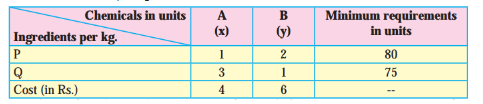
A factory produced two types of chemicals A and B. The following table gives the units of ingredients P and Q (per kg) of chemicals A and B as well as minimum requirements of P and Q and also cost per kg. chemicals A and B :

Image

Find the number of units of chemicals A and B should be produced so as to minimize the cost.

If $\text{y}=\text{a}\{\text{x}+\sqrt{\text{x}^2+1}\}^\text{n}+\text{b}\{\text{x}-\sqrt{\text{x}^2+1}\}^{-\text{n},}$ prove that $(\text{x}^2-1)\frac{\text{d}^2\text{y}}{\text{dx}^2}+\text{x}\frac{\text{dy}}{\text{dx}}-\text{n}^2\text{y}=0.$
Differentiate the following w. r. t. x.$y=\left(1+\cos ^2 x\right)^4 \times \sqrt{x+\sqrt{\tan x}}$
Find the angle between the follwing pairs of lines:$\vec{\text{r}}=\big(4\hat{\text{i}}-\hat{\text{j}}\big)+\lambda\big(\hat{\text{i}}+2\hat{\text{j}}-2\hat{\text{k}}\big)$ and $\vec{\text{r}}=\hat{\text{i}}-\hat{\text{j}}+2\hat{\text{k}}-\mu\big(2\hat{\text{i}}+4\hat{\text{j}}-4\hat{\text{k}}\big)$
Find the vector equation of the line passing through the points (-1, 0, 2) and (3, 4, 6).
Find the points o local maxima or local minima, if any, of the following functions, using the first derivatives test. Also, find the local maximum or local minimum values, as the case may be:
$\text{f}(\text{x})=\sin\text{x}-\cos(\text{x}), 0\leq\text{x}\leq2\pi$
Find the point on the curve $x^2=8 y$ which is nearest to the point $(2,4)$.
If the mean and variance of a random variable X having a binomial distribution are 4 and 2 respectively, find P (X = 1).
A plane passes through the point (1, -2, 5) and is perpendicular to the line joining the origin to the point $2\hat{\text{i}}+\hat{\text{j}}-\hat{\text{k}}.$ Find the vector and cartesian forms of the equation of the plane.
If $\text{y}=\text{x}\sin(\text{a}+\text{y}),$ prove that $\frac{\text{dx}}{\text{dx}}=\frac{\sin^2(\text{a}+\text{y})}{\sin(\text{a}+\text{y})-\text{y}\cos(\text{a}+\text{y})}$