Question
Evaluate the following integrals:$\int\frac{\text{x}^2+1}{\text{x}^2-5\text{x}+6}\text{ dx}$

Answer

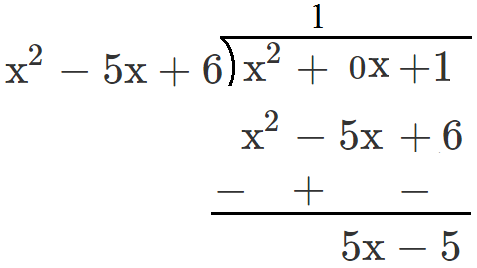
Let $\text{I}=\int\Big(\frac{\text{x}^2+1}{\text{x}^2-5\text{x}+6}\Big)\text{dx}$ Dividing Numerator by Denominator
$\frac{\text{x}^2+1}{\text{x}^2-5\text{x}+6}=1+\Big(\frac{5\text{x}-5}{\text{x}^2-5\text{x}+6}\Big)\ ....(1)$ Also $\frac{5\text{x}-5}{\text{x}^2-5\text{x}+6}=\frac{5\text{x}-5}{(\text{x}-2)(\text{x}-3)}$ Let $\Rightarrow\frac{5\text{x}-5}{(\text{x}-2)(\text{x}-3)}=\frac{\text{A}}{\text{x}-2}+\frac{\text{B}}{\text{x}-3}$ $\Rightarrow\frac{5\text{x}-5}{(\text{x}-2)(\text{x}-3)}=\frac{\text{A}(\text{x}-3)+\text{B}(\text{x}-2)}{(\text{x}-2)(\text{x}-3)}$ $\Rightarrow5\text{x}-5=\text{A}(\text{x}-3)+\text{B}(\text{x}-2)$ Let $\text{x}=3$ $5\times3-5=\text{}A\times0+\text{B}(3-2)$ $10=\text{B}$ Let $\text{x}=2$ $5\times2-5=\text{}A(2-3)+\text{B}\times0$ $\text{A}=-5$ $\Rightarrow\frac{5\text{x}-5}{(\text{x}-2)(\text{x}-3)}=\frac{-5}{\text{x}-2}+\frac{10}{\text{x}-3}\ ... ..(2)$ From (1) and (2) $\text{I}=\int\text{dx}-5\int\frac{\text{dx}}{\text{x}-2}+10\int\frac{\text{dx}}{\text{x}-3}$ $=\text{x}-5\log|\text{x}-2|+10\log|\text{x}-3|+\text{C}$

Need a full question paper?

Generate a complete, print-ready paper with questions like this in minutes — across 16+ boards, with answer keys.
Start Generating Free

Similar questions

The probability that A hits a target is $\frac{1}{3}$ and the probability that B hits it, is $\frac{2}{5}$, What is the probability that the target will be hit, if each one of A and B shoots at the target?
Differentiate the following functions with respect to x:
$\tan^{-1}\Big\{\frac{\text{x}}{1+\sqrt{1-\text{x}^3}}\Big\},-1<\text{x}<1$
Show that $\text{y}=\frac{\text{a}}{\text{x}}+\text{b}$ is a solution of the differential equation $\frac{\text{d}^2\text{y}}{\text{dx}^2}=\frac{2}{\text{x}}\Big(\frac{\text{dy}}{\text{dx}}\Big)=0$
find the area of the region ${(x, y) : y^2 < 8x, x^2 + y^2 < 9}.$
Prove that:
$\int\limits^\pi_0\text{xf}(\sin\text{x})\text{dx}=\frac{\pi}{2}\int\limits^\pi_0\text{f}(\sin\text{x})\text{dx}$
Evaluate the definite integral in Exercise:
$\int^{\frac{\pi}{3}}\limits_{\frac{\pi}{6}}\frac{\sin\text{x}+\cos\text{x}}{\sqrt{\sin2\text{x}}}\text{dx}$
Find the points o local maxima or local minima, if any, of the following functions, using the first derivatives test. Also, find the local maximum or local minimum values, as the case may be: $f(x) = (x - 1)(x + 2)^2$​​​​​​​
Find the angle between the vectors whose direction cosines are proportional to 2, 3, -6 and 3, -4, 5.
Solve the following differential equations $(1+\text{x}^2)\frac{\text{dy}}{\text{dx}}+(1+\text{y}^2)=0,$ given that $\text{y}=1,$ when $\text{x}=0.$
Solve the following differential equation:
$\frac{\text{dy}}{\text{dx}}=\frac{(\text{x}-\text{y})+3}{2(\text{x}-\text{y})+5}$