Question
Evaluate the following integrals:$\int\frac{\text{x}^2+1}{\text{x}^2-5\text{x}+6}\text{ dx}$

Answer

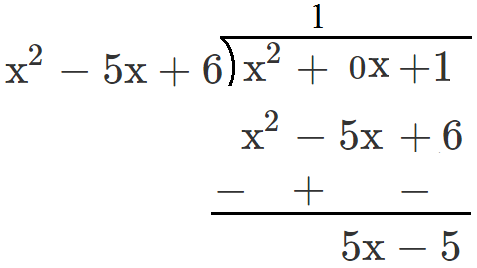
Let $\text{I}=\int\Big(\frac{\text{x}^2+1}{\text{x}^2-5\text{x}+6}\Big)\text{dx}$ Dividing Numerator by Denominator
$\frac{\text{x}^2+1}{\text{x}^2-5\text{x}+6}=1+\Big(\frac{5\text{x}-5}{\text{x}^2-5\text{x}+6}\Big)\ ....(1)$ Also $\frac{5\text{x}-5}{\text{x}^2-5\text{x}+6}=\frac{5\text{x}-5}{(\text{x}-2)(\text{x}-3)}$ Let $\Rightarrow\frac{5\text{x}-5}{(\text{x}-2)(\text{x}-3)}=\frac{\text{A}}{\text{x}-2}+\frac{\text{B}}{\text{x}-3}$ $\Rightarrow\frac{5\text{x}-5}{(\text{x}-2)(\text{x}-3)}=\frac{\text{A}(\text{x}-3)+\text{B}(\text{x}-2)}{(\text{x}-2)(\text{x}-3)}$ $\Rightarrow5\text{x}-5=\text{A}(\text{x}-3)+\text{B}(\text{x}-2)$ Let $\text{x}=3$ $5\times3-5=\text{}A\times0+\text{B}(3-2)$ $10=\text{B}$ Let $\text{x}=2$ $5\times2-5=\text{}A(2-3)+\text{B}\times0$ $\text{A}=-5$ $\Rightarrow\frac{5\text{x}-5}{(\text{x}-2)(\text{x}-3)}=\frac{-5}{\text{x}-2}+\frac{10}{\text{x}-3}\ ... ..(2)$ From (1) and (2) $\text{I}=\int\text{dx}-5\int\frac{\text{dx}}{\text{x}-2}+10\int\frac{\text{dx}}{\text{x}-3}$ $=\text{x}-5\log|\text{x}-2|+10\log|\text{x}-3|+\text{C}$

Need a full question paper?

Generate a complete, print-ready paper with questions like this in minutes — across 16+ boards, with answer keys.
Start Generating Free

Similar questions

Solve the following differential equation:$\frac{\text{dy}}{\text{dx}}+2\text{y}=4\text{x}$
If f is an integrable function such that f(2a - x) = f(x), then prove that:$\int\limits^{2\text{a}}_0\text{f(x)}\text{dx}=2\int\limits^{\text{a}}_0\text{f(x)}\text{dx}$
If $\log y=\log (\sin x)-x^2$, show that $\frac{d^2 y}{d x^2}+4 x \frac{d y}{d x}+\left(4 x^2+3\right) y=0$
Find the inverse of the following matrices by using elementry row transformation:$\begin{bmatrix} 1 & 3 & -2 \\ -3 & 0 & -1 \\ 2 & 1 & 0 \end{bmatrix}$
Using differentials, find the approximate values of the following:
$\cos61^\circ$ it being given that $\sin60^\circ=0.86603$ and $0.01745$ radian
Solve the following differential equation:
$\text{y}^2\text{dx}+(\text{x}^2-\text{xy}+\text{y}^2)\text{dy}=0$
If $\text{y}=(\cot^{-1}\text{x})^2$ prove that $\text{y}^2(\text{x}^2+1)^2+2\text{x}(\text{x}^2+1)\text{y}_1=2.$
Let $\vec{\text{a}}=\hat{\text{i}}+4\hat{\text{j}}+2\hat{\text{k}},\vec{\text{b}}=3\hat{\text{i}}-2\hat{\text{j}}+7\hat{\text{k}}$ and $\vec{\text{c}}=2\hat{\text{i}}-\hat{\text{j}}+4\hat{\text{k}}.$Find a vector $\vec{\text{d}}$ which is perpendicular to both $\vec{\text{a}}$ and $\vec{\text{d}}$ and $\vec{\text{c}}.\vec{\text{d}}=15.$
Evaluate the following integrals:$\int\limits^{\text{a}}_{-\text{a}}\frac{1}{1+\text{a}^{\text{x}}}\text{ dx},\text{ a}>0$
If A and B are two events such that,
$\text{P(A)}=\frac{1}{3},\text{P(B)}=\frac{1}{4}$ and $\text{P}(\text{A}\cap\text{B})=\frac{5}{12},$ then find P(A|B) and P(B|A).