Question
Evaluate the following integrals:
$\int\frac{\text{x}^2\sin^{-1}\text{x}}{(1-\text{x}^2)^{\frac{3}{2}}}\text{dx}$

Answer

Let $\text{I}=\int\frac{\text{x}^2\sin^{-1}\text{x dx}}{(1-\text{x}^2)^{\frac{3}{2}}}$
Putting $\text{x}=\sin\theta$
$\Rightarrow\text{dx}=\cos\theta\text{d}\theta$
$\&\ \theta=\sin^{-1}\text{x}$
$\therefore\text{I}=\int\frac{\sin^2\theta.\theta.\cos\theta\text{d}\theta}{(1-\sin^2\theta)^{\frac{3}{2}}}$
$=\int\frac{\sin^2\theta.\theta.\cos\theta\text{d}\theta}{(\cos^2\theta)^{\frac{3}{2}}}$
$=\int\frac{\sin^2\theta.\theta.\cos\theta\text{d}\theta}{\cos^3\theta}$
$=\int\tan^2\theta.\theta.\text{d}\theta$
$=\int(\sec^2\theta-1)\theta.\text{d}\theta$.
$=\int\theta.\sec^2\theta\text{d}\theta-\int\theta.\text{d}\theta$
$=\theta\int\sec^2\theta\text{d}\theta-\int\Big\{\frac{\text{d}}{\text{d}\theta}(\theta)\int\sec^2\theta\text{d}\theta\Big\}\text{d}\theta-\int\theta.\text{d}\theta$
$=\theta\tan\theta-\int1.\tan\theta\text{d}\theta-\frac{\theta^{\ 2}}{2}$
$=\theta.\tan\theta-\ln\big|\sec\theta\big|-\frac{\theta^{\ 2}}{2}+\text{C}$
$=\theta.\frac{\sin\theta}{\cos\theta}+\ln\big|\cos\theta\big|-\frac{\theta^{\ 2}}{2}+\text{C}$
$=\theta.\frac{\sin\theta}{\cos\theta}+\ln\Big|\sqrt{1-\sin^2\theta}\Big|-\frac{\theta^{\ 2}}{2}+\text{C}$
$=\frac{\theta.\sin\theta}{\sqrt{1-\sin^2\theta}}+\frac{1}2\ln\Big|1-\sin^2\theta\Big|-\frac{\theta^{\ 2}}{2}+\text{C}$
$=\frac{\text{x}\sin^{-1}\text{x}}{\sqrt{1-\text{x}^2}}+\frac{1}{2}\ln\big(1-\text{x}^2\big)-\frac{1}{2}\big(\sin^{-1}\text{x}\big)^2+\text{C}$$\Big[\because\theta=\sin^{-1}\text{x}\Big]$

Need a full question paper?

Generate a complete, print-ready paper with questions like this in minutes — across 16+ boards, with answer keys.
Start Generating Free

Similar questions

$\text{If y}=3\cos(\log \text{x})+4\sin(\log\text{x}),\text{ show that }\text{x}^2\text{y}_2+\text{xy}_1+\text{y}=0$
Find the equations of the planes parallel to the plane x - 2y + 2z - 3 = 0 and which are at a unit distance from the point (1, 1, 1).
Solve the following differential equations:
$\frac{\text{dy}}{\text{dx}}=\frac{\text{x + y}}{\text{x}-\text{y}}$
Find $\frac{\text{dy}}{\text{dx}}$ in the following cases:
$y^3 - 3xy^2 = x^3 + 3x^2y$
Find the equation of the sphere passing through the points $(0, 0, 0), (a, 0, 0), (0, b, 0)$ and $(0, 0, c).$
An aeroplane can carry a maximum of 200 passengers. A profit of Rs.1000 is made on each executive class ticket and a profit of Rs.600 is made on each economy class ticket. The airline reserves atleast 20 seats for executive class. However, atleast 4 times as many passengers prefer to travel by economy class than by the executive class. Determine how many tickets of each type must be sold in order to maximise the profit of the airline. What is the maximum profit?
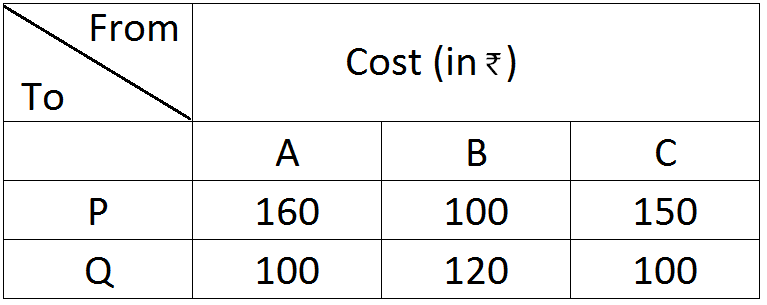
There are two factories located one at place P and the other at place Q. From these locations, a certain commodity is to be delivered to each of the three depots situated at A, B and C. The weekly requirements of the depots are respectively 5, 5 and 4 units of the commodity while the production capacity of the factories at P and Q are respectively 8 and 6 units. The cost of transportation per unit is given below:
How many units should be transported from each factory to each depot in order that the transportation cost is minimum. What will be the minimum transportation cost?
Evaluate the following integrals:
$\int\limits^{\pi}_0\frac{\text{x}}{1+\cos\alpha\sin\text{x}}\text{ dx},0<\alpha<\pi$
A letter is known to have come either from LONDON or CLIFTON. On the envelope just two consecutive letters ON are visible. What is the probability that the letter has come from,CLIFTON?
Let $A = \{1, 2, 3\}$. Then, the number of equivalence relations containing $(1, 2)$ is: