Question
Evaluate the following integrals:$\int\frac{\text{x}^2}{\text{x}^2+6\text{x}+12}\text{ dx}$
Answer

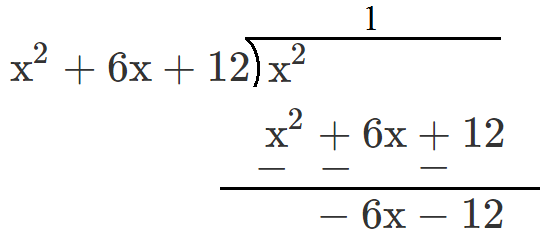
Let $\text{I}=\int\frac{\text{x}^2\text{ dx}}{\text{x}^2+6\text{x}+12}$ Now,
Therefore,
$\frac{\text{x}^2}{\text{x}^2+6\text{x}+12}=1-\frac{(6\text{x}+12)}{\text{x}^2+6\text{x}+12}\ ....(1)$Let $6\text{x}+12=\text{A}\frac{\text{d}}{\text{dx}}\big(\text{x}^2+6\text{x}+12\big)+\text{B}$
$\Rightarrow6\text{x}+12=\text{A}(2\text{x}+6)+\text{B}$
$\Rightarrow6\text{x}+12=(2\text{A})\text{x}+6\text{A}+\text{B}$
Equating coefficients of like terms $2\text{A}=6$ $\text{A}=3$ $6\text{A}+\text{B}=12$ $18+\text{B}=12$ $\text{B}=-6$ $\therefore\ \frac{\text{x}^2}{\text{x}^2+6\text{x}+12}=1-\frac{3(2\text{x}+6)}{\text{x}^2+6\text{x}+12}$ $\text{I}=\int\frac{\text{x}^2\text{ dx}}{\text{x}^2+6\text{x}+12}$ $=\int\text{dx}-3\int\frac{(2\text{x}+6)\text{ dx}}{\text{x}^2+6\text{x}+12}+6\int\frac{\text{dx}}{\text{x}^2+6\text{x}+12}$ $=\int\text{dx}-3\int\frac{(2\text{x}+6)\text{ dx}}{\text{x}^2+6\text{x}+12}+6\int\frac{\text{dx}}{\text{x}^2+6\text{x}+9+3}$ $=\int\text{dx}-3\int\frac{(2\text{x}+6)\text{ dx}}{\text{x}^2+6\text{x}+12}+6\int\frac{\text{dx}}{(\text{x}+3)^2+\big(\sqrt3\big)^2}$ $=\text{x}-3\log\big|\text{x}^2+6\text{x}+12\big|+\frac{6}{\sqrt3}\tan^{-1}\Big(\frac{\text{x}+3}{\sqrt3}\Big)+\text{C}$ $=\text{x}-3\log\big|\text{x}^2+6\text{x}+12\big|+2\sqrt3\tan^{-1}\Big(\frac{\text{x}+3}{\sqrt3}\Big)+\text{C}$

Need a full question paper?

Generate a complete, print-ready paper with questions like this in minutes — across 16+ boards, with answer keys.

Start Generating Free

Similar questions

Find the solution of $\frac{\text{dy}}{\text{dx}}=2^\text{y-x}.$
There are three urns A, B, and C. Urn A contains 4 red balls and 3 black balls. urn B contains 5 red balls and 4 black balls. Urn C contains 4 red and 4 black balls. One ball is drawn from each of these urns. What is the probability that 3 balls drawn consists of 2 red balls and a black ball?
Show that the curves $2x = y^2$ and $2xy = k$ cut at right angles, if $k^2 = 8.$
If $\text{A}=\begin{bmatrix}1&1\\0&1\end{bmatrix},$ prove that $\text{A}^\text{n}=\begin{bmatrix}1&\text{n}\\0&1\end{bmatrix}$ for all positive integers n.
Find the distance of the point (-1, -5, -10) from the point of intersection of the line $\vec{\text{r}}=(2\hat{\text{i}}-\hat{\text{j}}+2\hat{\text{k}})+\lambda(3\hat{\text{i}}+4\hat{\text{j}}+2\hat{\text{k}})$ and the plane $\vec{\text{r}}\cdot(\hat{\text{i}}-\hat{\text{j}}+\hat{\text{k}})=5.$
Evaluate the following intregals:
$\int\frac{1}{1+3\sin^2\text{x}}\text{ dx}$
Form the differential equation of the family of curves represented by the equation (a being the perimeter):$(\text{x}-\text{a})^2+2\text{y}^2=\text{a}^2$
Solve the following differential equation:
x dy – y dx = $\sqrt{\text{x}^{2}+\text{y}^{2}}\text{ dx}$ .
Two balls are drawn at random with replacement from a box containing 10 black and 8 red balls. Find the probability that,
  1. Both balls are red,
  2. First ball is black and second is red,
  3. One of them is black and other is red.
A window is in the form of a rectangle surmounted by a semicircular opening. The total perimeter of the window is $10 m.$ Find the dimensions of the window to admit maximum light through the whole opening