Question
Evaluate the following integrals:$\int\frac{\text{x}^2}{\text{x}^2+6\text{x}+12}\text{ dx}$
Answer

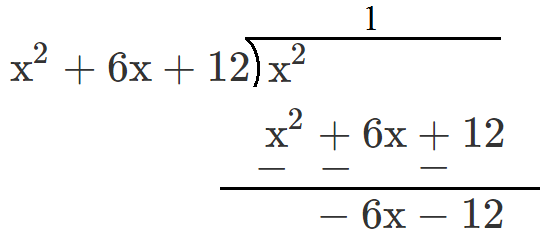
Let $\text{I}=\int\frac{\text{x}^2\text{ dx}}{\text{x}^2+6\text{x}+12}$ Now,
Therefore,
$\frac{\text{x}^2}{\text{x}^2+6\text{x}+12}=1-\frac{(6\text{x}+12)}{\text{x}^2+6\text{x}+12}\ ....(1)$Let $6\text{x}+12=\text{A}\frac{\text{d}}{\text{dx}}\big(\text{x}^2+6\text{x}+12\big)+\text{B}$
$\Rightarrow6\text{x}+12=\text{A}(2\text{x}+6)+\text{B}$
$\Rightarrow6\text{x}+12=(2\text{A})\text{x}+6\text{A}+\text{B}$
Equating coefficients of like terms $2\text{A}=6$ $\text{A}=3$ $6\text{A}+\text{B}=12$ $18+\text{B}=12$ $\text{B}=-6$ $\therefore\ \frac{\text{x}^2}{\text{x}^2+6\text{x}+12}=1-\frac{3(2\text{x}+6)}{\text{x}^2+6\text{x}+12}$ $\text{I}=\int\frac{\text{x}^2\text{ dx}}{\text{x}^2+6\text{x}+12}$ $=\int\text{dx}-3\int\frac{(2\text{x}+6)\text{ dx}}{\text{x}^2+6\text{x}+12}+6\int\frac{\text{dx}}{\text{x}^2+6\text{x}+12}$ $=\int\text{dx}-3\int\frac{(2\text{x}+6)\text{ dx}}{\text{x}^2+6\text{x}+12}+6\int\frac{\text{dx}}{\text{x}^2+6\text{x}+9+3}$ $=\int\text{dx}-3\int\frac{(2\text{x}+6)\text{ dx}}{\text{x}^2+6\text{x}+12}+6\int\frac{\text{dx}}{(\text{x}+3)^2+\big(\sqrt3\big)^2}$ $=\text{x}-3\log\big|\text{x}^2+6\text{x}+12\big|+\frac{6}{\sqrt3}\tan^{-1}\Big(\frac{\text{x}+3}{\sqrt3}\Big)+\text{C}$ $=\text{x}-3\log\big|\text{x}^2+6\text{x}+12\big|+2\sqrt3\tan^{-1}\Big(\frac{\text{x}+3}{\sqrt3}\Big)+\text{C}$

Need a full question paper?

Generate a complete, print-ready paper with questions like this in minutes — across 16+ boards, with answer keys.

Start Generating Free

Similar questions

If $\text{y}=\log\frac{\text{x}^2+\text{x}+1}{\text{x}^2-\text{x}+1}+\frac{2}{\sqrt{3}}\tan^{-1}\Big(\frac{\sqrt{3}\text{x}}{1-\text{x}^2}\Big),$ find $\frac{\text{dy}}{\text{dx}}$
Using integration, find the area of the following region:
$\Big\{(\text{x},\text{y}):\frac{\text{x}^2}{9}+\frac{\text{y}^2}{4}\leq1\leq\frac{\text{x}}{3}+\frac{\text{y}}{2}\Big\}$
Solve the following initial value problems:
$(\text{y}^4-2\text{x}^3\text{y})\text{dx}+(\text{x}^4-2\text{xy}^3)\text{dy}=0,\text{y}(1)=1$
Evaluate the following definite integrals:$\int_{0}^\limits{\infty}\frac{1}{\text{a}^2+\text{b}^2\text{x}^2} \text{ dx}$
Differentiate the following functions with respect to x:
$(\cos\text{x})^\text{x}+(\sin\text{x})^\frac{1}{\text{x}}$
Find the equations of the tangent and the normal to the following curves at the indicated points.
$\frac{\text{x}^2}{\text{a}^2}-\frac{\text{y}^2}{\text{b}^2}=1\text{ at }(\text{x}_1,\text{y}_1)$
A small manufacturing firm produces two types of gadgets A and B, which are first processed in the foundry, then sent to the machine shop for finishing. The number of man-hours of labour required in each shop for the production of each unit of A and B, and the number of man-hours the firm has available per week are as follows:
Gadget
Fondry
Machine-shop
A
B
10
6
5
4
Firm's capacity per week
1000
600
The profit on the sale of A is Rs. 30 per unit as compared with Rs. 20 per unit of B. The problem is to determine the weekly production of gadgets A and B, so that the total profit is maximized. Formulate this problem as a LPP.
Evaluate the following integrals as limit of sum:$\int\limits^{4}_{1}\big(3\text{x}^2+2\text{x}\big)\text{dx}$
Show that the following system of linear equations is consistent and also find solutions:
$5x +3y + 7z = 4$
$3x + 26y + 2z = 9$
$7x + 2y + 10z = 5$
Find a point on the curve $y = x^3 - 3x$ where the tangent is parallel to the chord joining $(1, -2)$ and $(2, 2)$.