Question
Evaluate the following integrals:
$\int(\text{x}+2)\sqrt{\text{x}^2+\text{x}+1}\text{dx}$

Answer

Let $\text{I}=\int(\text{x}+2)\sqrt{\text{x}^2+\text{x}+1}\text{dx}$
Let $\text{x}+2=\lambda\frac{\text{d}}{\text{dx}}(\text{x}^2+\text{x}+1)+\mu$
$=\lambda(2\text{x}+1)+\mu$
Equating similar terms, we get,
$2\lambda=1\Rightarrow\lambda=\frac{1}{2}$
$\lambda+\mu=2\Rightarrow\mu=2-\lambda=\frac{3}{2}$
$\therefore\ \mu=\frac{3}{2}$
$\therefore\ \text{I}=\int\Big(\frac{1}{2}(2\text{x}+1)+\frac{3}{2}\Big)\sqrt{\text{x}^2+\text{x}+1}\text{dx}$
$=\frac{1}{2}\int(2\text{x}+1)\sqrt{\text{x}^2+\text{x}+1}+\frac{3}{2}\int\sqrt{\text{x}^2+\text{x}+1}\text{dx}$
Let $\text{x}^2+\text{x}+1=\text{t}$
$(2\text{x}+1)\text{dx = dt}$
$\therefore\ \text{I}=\frac{1}{2}\int\sqrt{\text{t}}\text{dt}+\frac{3}{2}\int\sqrt{\Big(\text{x}+\frac{1}{2}\Big)^2+\Big(\frac{\sqrt3}{2}\Big)^2}\text{dx}$
$\Rightarrow\text{I}=\frac{1}{2}\frac{\text{t}^{\frac{3}{2}}}{\frac{3}{2}}+\frac{3}{2}\begin{Bmatrix}\frac{\big(\text{x}+\frac{1}{2}\big)}{2}\sqrt{\text{x}^2+\text{x}+1}\\+\frac{3}{8}\log\Big|\Big(\text{x}+\frac{1}{2}\Big)+\sqrt{\text{x}^2+\text{x}+1}\Big|\end{Bmatrix}+\text{C}$
Hence,
$\Rightarrow\text{I}=\frac{1}{3}(\text{x}^2+\text{x}+1)^{\frac{3}{2}}+\frac{3}{8}(2\text{x}+1)\sqrt{\text{x}^2+\text{x}+1}\\+\frac{9}{16}\log\Big|\Big(\text{x}+\frac{1}{2}\Big)+\sqrt{\text{x}^2+\text{x}+1}\Big|+\text{C}$

Need a full question paper?

Generate a complete, print-ready paper with questions like this in minutes — across 16+ boards, with answer keys.
Start Generating Free

Similar questions

Find the distance between the point (-1, -5, -10) and the point of intersection of the line $\frac{x - 2}{3} = \frac{y + 1}{4} = \frac{z - 2}{12}$ and the plane $x - y + z = 5.$
If $\text{xy}\log(\text{x}+\text{y})=1,$ prove that $\frac{\text{dy}}{\text{dx}}=\frac{\text{y}(\text{x}^2\text{y}+\text{x}+\text{y})}{\text{x}(\text{xy}^2+\text{x}+\text{y})}$
Evaluate the following intregals:
$\int\frac{\text{x}^2}{\text{x}^4-\text{x}^2-12}\ \text{dx}$
Find the value of a and b so that the function f given by $\text{f(x)}=\begin{cases}1,&\text{if }\text{ x}\leq3\\\text{ax}+\text{b},&\text{if }3<\text{x}<5\\7,&\text{if }\text{ x}\geq5\end{cases}$ is continuous x = 3 and x = 5.
Solve the following system of equations by matrix method:
$3x + y = 19$
$3x - y = 23$
Let $Z$ be the set of all integers and $Z_0$ be the set of all non$-$zero integers. Let a relation $R$ on $Z \times Z_0$ be defined as $(a, b)R(c, d) \rightarrow ad = bc$ for all $(a, b), (c, d) \in Z \times Z_0,$ Prove that $R$ is an equivalence relation on $Z \times Z_0.$
Find the binomial distribution whose mean is 5 and variance $\frac{10}{3}.$
Maximize $Z = 3x_1 + 4x_2,$ if possible, Subject to the constraints $\text{x}_1-\text{x}_2\leq-1, -\text{x}_1+\text{x}_2\leq0 , \text{x}_1,\text{x}_2\geq0$
Discuss the continuity of the function f, where f is defined by
$\text{f(x)}= \begin{cases}\ 3,\ \ \text{if}\ 0\leq \text{x}\leq 1 \\4,\ \ \text{if}\ 1<\text{x}<3\\5,\ \text{if}\ 3\leq\text{x}\leq10\end{cases}$
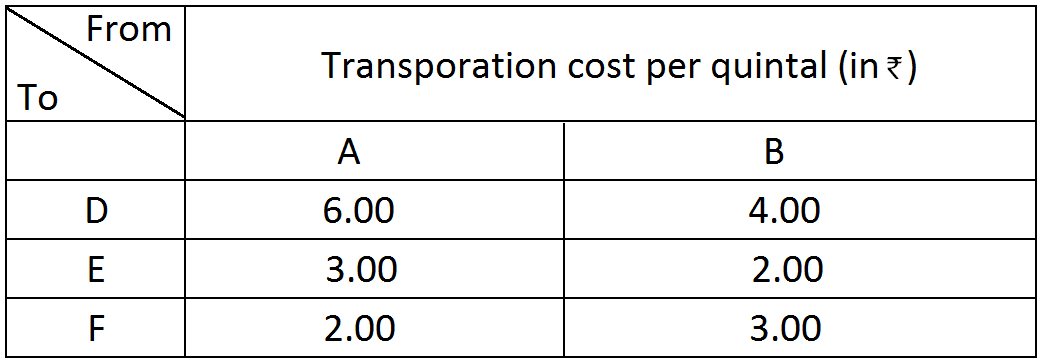
Tow godowns$, A$ and $B,$ have grain storage capacity of $100$ quintals and $50$ quintals respectively. They supply to $3$ ration shops, $D, E$ and $F,$ whose requirements are $60, 50$ and $40$ quintals respectively. The cost of transportation per quintal from the godowns to the shops are given in the following table:
How should the supplies be transported in order that the transportation cost is minimum?