Question
Evaluate the following integrals:$\int\frac{(\text{x}-1)^2}{\text{x}^2+2\text{x}+2}\text{ dx}$
Answer

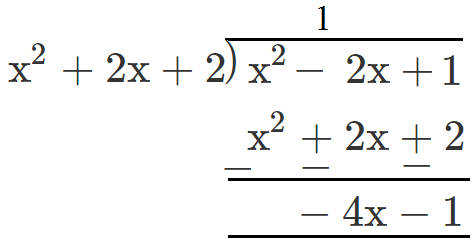
Let $\int\frac{(\text{x}-1)^2}{\text{x}^2+2\text{x}+2}\text{ dx}$ $=\int\Big(\frac{\text{x}^2-2\text{x}+1}{\text{x}^2-2\text{x}+2}\Big)\text{dx}$ Here,
Therefore,
$\frac{\text{x}^2-2\text{x}+1}{\text{x}^2+2\text{x}+2}=1-\frac{(4\text{x}+1)}{\text{x}^2+2\text{x}+2}\ ....(1)$ Let $4\text{x}+1=\text{A}\frac{\text{d}}{\text{dx}}\big(\text{x}^2+2\text{x}+2\big)+\text{B}$ $4\text{x}+1=\text{A}(2\text{x}+2)+\text{B}$ $4\text{x}+1=(2\text{A})\text{x}+2\text{A}+\text{B}$ Equating Cofficients of like terms $2\text{A}=4$ $\text{A}=2$ $2\text{A}+\text{B}=1$ $2\times2+\text{B}=1$ $\text{B}=-3$ $\int\Big(\frac{\text{x}^2-2\text{x}+1}{\text{x}^2-2\text{x}+2}\Big)\text{dx}$ $=\int\text{dx}-2\int\frac{(2\text{x}+2)}{\text{x}^2+2\text{x}+2}\text{ dx}+3\int\frac{\text{ dx}}{\text{x}^2+2\text{x}+2}$ $=\int\text{dx}-2\int\frac{(2\text{x}+2)}{\text{x}^2+2\text{x}+2}\text{ dx}+3\int\frac{\text{dx}}{(\text{x}+1)^2+1^2}$ $=\text{x}-2\log\big|\text{x}^2+2\text{x}+2\big|+\frac{3}{1}\tan^{-1}\Big(\frac{\text{x}+1}{1}\Big)+\text{C}$ $=\text{x}-2\log\big|\text{x}^2+2\text{x}+2\big|+3\tan^{-1}(\text{x}+1)+\text{C}$

Need a full question paper?

Generate a complete, print-ready paper with questions like this in minutes — across 16+ boards, with answer keys.

Start Generating Free

Similar questions

Find the adjoint of the following matrices: $\begin{bmatrix} \text{a} & \text{b} \\ \text{c} & \text{d} \end{bmatrix}$Verify that $($adjoint $A) A = |A|I = A ($adjoint $A)$ for the above matrices.
Find the distance between the point (-1, -5, -10) and the point of intersection of the line $\frac{x - 2}{3} = \frac{y + 1}{4} = \frac{z - 2}{12}$ and the plane $x - y + z = 5.$
Find the slopes of the tangent and the normal to the following curves at the indicated points:
$\text{y}=(\sin2\text{x}+\cot\text{x}+2)^2\text{at}\text{ x}=\frac{\pi}{2}$
Using integration find the area of the triangular region whose sides have equations y = 2x + 1, y = 3x + 1 and x = 4.
Evaluate the following integrals as limit of sum:
$\int\limits^2_0(\text{x}+3)\text{dx}$
Find the value of k if the function: $f (x) = \begin{matrix} kx^{2}& x\geq 1 & \\ 4 & x< 1 & \\ \end{matrix} \text{is continuous at x = 1} $ 
Prove that:
$\begin{vmatrix}\text{a}^2&2\text{ab}&\text{b}^2\\\text{b}^2&\text{a}^2&2\text{ab}\\2\text{ab}&\text{b}^2&\text{a}^2\end{vmatrix}=(\text{a}^3+\text{b}^3)^2$
If $\text{x}\sqrt{1+\text{y}}+\text{y}\sqrt{1+\text{x}}=0,$ prove that $(1+\text{x})^2\frac{\text{dx}}{\text{dx}}+1=0$
If $xy = e^{x-y},$ find $\frac{\text{dy}}{\text{dx}}$
Find the angle between the follwing pairs of lines$: \vec{\text{r}}=\big(4\hat{\text{i}}-\hat{\text{j}}\big)+\lambda\big(\hat{\text{i}}+2\hat{\text{j}}-2\hat{\text{k}}\big)$ and $\vec{\text{r}}=\hat{\text{i}}-\hat{\text{j}}+2\hat{\text{k}}-\mu\big(2\hat{\text{i}}+4\hat{\text{j}}-4\hat{\text{k}}\big)$