Question
Evaluate the following integrals:$\int\frac{\text{x}^2}{\text{x}^2+6\text{x}+12}\text{ dx}$

Answer

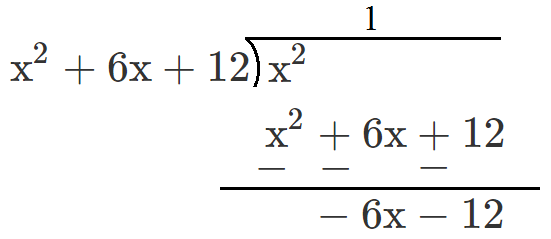
Let $\text{I}=\int\frac{\text{x}^2\text{ dx}}{\text{x}^2+6\text{x}+12}$ Now,
Therefore,
$\frac{\text{x}^2}{\text{x}^2+6\text{x}+12}=1-\frac{(6\text{x}+12)}{\text{x}^2+6\text{x}+12}\ ....(1)$Let $6\text{x}+12=\text{A}\frac{\text{d}}{\text{dx}}\big(\text{x}^2+6\text{x}+12\big)+\text{B}$
$\Rightarrow6\text{x}+12=\text{A}(2\text{x}+6)+\text{B}$
$\Rightarrow6\text{x}+12=(2\text{A})\text{x}+6\text{A}+\text{B}$
Equating coefficients of like terms $2\text{A}=6$ $\text{A}=3$ $6\text{A}+\text{B}=12$ $18+\text{B}=12$ $\text{B}=-6$ $\therefore\ \frac{\text{x}^2}{\text{x}^2+6\text{x}+12}=1-\frac{3(2\text{x}+6)}{\text{x}^2+6\text{x}+12}$ $\text{I}=\int\frac{\text{x}^2\text{ dx}}{\text{x}^2+6\text{x}+12}$ $=\int\text{dx}-3\int\frac{(2\text{x}+6)\text{ dx}}{\text{x}^2+6\text{x}+12}+6\int\frac{\text{dx}}{\text{x}^2+6\text{x}+12}$ $=\int\text{dx}-3\int\frac{(2\text{x}+6)\text{ dx}}{\text{x}^2+6\text{x}+12}+6\int\frac{\text{dx}}{\text{x}^2+6\text{x}+9+3}$ $=\int\text{dx}-3\int\frac{(2\text{x}+6)\text{ dx}}{\text{x}^2+6\text{x}+12}+6\int\frac{\text{dx}}{(\text{x}+3)^2+\big(\sqrt3\big)^2}$ $=\text{x}-3\log\big|\text{x}^2+6\text{x}+12\big|+\frac{6}{\sqrt3}\tan^{-1}\Big(\frac{\text{x}+3}{\sqrt3}\Big)+\text{C}$ $=\text{x}-3\log\big|\text{x}^2+6\text{x}+12\big|+2\sqrt3\tan^{-1}\Big(\frac{\text{x}+3}{\sqrt3}\Big)+\text{C}$

Need a full question paper?

Generate a complete, print-ready paper with questions like this in minutes — across 16+ boards, with answer keys.

Start Generating Free

Similar questions

Solve the following differential equation:
$2\text{xy dx}+(\text{x}^2+2\text{y}^2)\text{dy}=0$
The two vectors $\hat{\text{j}}+\hat{\text{k}}$ and $3\hat{\text{i}}-\hat{\text{j}}+4\hat{\text{k}}$ represents the sides $\overrightarrow{\text{AB}}$ and $\overrightarrow{\text{AC}}$ respectively of a triangle ABC. Find the length of the median through A.
Prove the following identities: $\begin{vmatrix}\text{x}+\lambda&2\text{x}&2\text{x}\\2\text{x}&\text{x}+\lambda&2\text{x}\\2\text{x}&2\text{x}&\text{x}+\lambda\end{vmatrix} =(5\text{x}+\lambda)(\lambda-\text{x})^2$
Differentiate the following functions with respect to x:
$\log(\text{x}+\sqrt{\text{x}^2+1})$
A farmer has a 100 acre farm. He can sell the tomatoes, lettuce, or radishes he can raise. The price he can obtain is Rs 1 per kilogram for tomatoes, Rs 0.75 a head for lettuce and Rs 2 per kilogram for radishes. The average yield per acre is 2000 kgs for radishes, 3000 heads of lettuce and 1000 kilograms of radishes. Fertilizer is available at Rs 0.50 per kg and the amount required per acre is 100 kgs each for tomatoes and lettuce and 50 kilograms for radishes. Labour required for sowing, cultivating and harvesting per acre is 5 man-days for tomatoes and radishes and 6 man-days for lettuce. A total of 400 man-days of labour are available at Rs 20 per man-day. Formulate this problem as a LPP to maximize the farmer's total profit.
If the sum of lengths of the hypotenuse and a side of a right angled triangle is given, show that the area of the triangle is maximum, when the angle between them is $\frac{\pi}{3}$
The random variable $X$ can take only the values $0, 1, 2.$ Given that $P(X = 0) = P (X = 1) = p$ and that $E(X^2) = E[X], $ find the value of $p.$
In the following, find the value of the constant k so that the given function is continuous at the indicated point:
$\text{f(x)}=\begin{cases}(\text{x}-1)\tan\frac{\pi\text{x}}{2},&\text{if}\text{ x}\neq1\\\text{k},&\text{if}\text{ x}=1\end{cases}\text{at x} = 1$
Maximise Z = 5x + 3y
subject to $3\text{x}+5\text{y}\leq15,\ 5\text{x}+2\text{y}\leq10,\ \text{x}\geq0,\ \text{y}\geq0.$
Evaluate:$\DeclareMathOperator*{\median}{\text{lim}} \median_{\text{x}\rightarrow0}\frac{\text{tan x - sin x}}{\sin^{3}\text{x}}$.