Question
Evaluate the following intregals:
$\int\frac{\text{x}}{\sqrt{\text{x}^2+6\text{x}+10}}\ \text{dx}$

Answer

Let $\text{I}\int\frac{\text{x}}{\sqrt{\text{x}^2+6\text{x}+10}}\ \text{dx}$
Let $\text{x}=\lambda\frac{\text{d}}{\text{dx}}(\text{x}^2+6\text{x}+10)+\mu$
$=\lambda(2\text{x}+6)+\mu$
$\text{x}=(2\lambda)\text{x}+6\lambda+\mu$
Comparing the co-efficient of like powers of x.
$2\lambda=1\Rightarrow\lambda=\frac{1}{2}$
$6\lambda+\mu=0\Rightarrow6\Big(\frac{1}{2}\Big)+\mu=0$
$\mu=-3$
So, $\text{I}_1=\int\frac{\frac{1}{2}(2\text{x}+6)=3}{\sqrt{\text{x}^2+6\text{x}+10}}\ \text{dx}$
$\frac{1}{2}\int\frac{{2\text{x}+6}=3}{\sqrt{\text{x}^2+6\text{x}+10}}\ \text{dx}-3\text{ I }\frac{1}{\sqrt{\text{x}^2+2\text{x}(3)+(3)^2+10}}$
$\text{I}_1=\frac{1}{2}\int\frac{2\text{x}+6}{\sqrt{\text{x}^2+6\text{x}+10}}\ \text{dx}-3\int\frac{1}{\sqrt{(\text{x}+3)^2+(1)^2}}\text{dx}$
$\text{I}=\sqrt{\text{x}^2+6\text{x}+10}-3\log\big|\text{x}+3+\sqrt{\text{x}^2+6\text{x}+10}\big|+\text{c}$
$\text{I}_1=\frac{1}{2}(2\sqrt{\text{x}^2+6\text{x}+10})-3\log\big|\text{x}+3+\sqrt{(\text{x}+3)^2+1}\big|+\text{c}$  $\Big[\text{since},\int\frac{1}{\sqrt{\text{x}}}\text{dx}-2\sqrt{\text{x}}+\text{c},\int\frac{1}{\sqrt{\text{x}^2+\text{a}^2}}\text{dx}-\log\big|\text{x}+\sqrt{\text{x}}^2+\text{a}^2\big|+\text{c}\Big]$
$\text{I}=\sqrt{\text{x}^2+6\text{x}+10}-3\log\big|\text{x}+3+\sqrt{\text{x}^2+6\text{x}+10}\big|+\text{c}$

Need a full question paper?

Generate a complete, print-ready paper with questions like this in minutes — across 16+ boards, with answer keys.
Start Generating Free

Similar questions

$\text{If}\cos^{-1}\frac{x}{\text{a}} + \cos^{-1}\frac{y}{\text{b}} = \alpha, \text{Prove that}\frac{{x}^{2}}{\text{a}^{2}} - 2\frac{xy}{\text{ab}}\cos\alpha +\frac{{y}^{2}}{\text{b}^{2}} = \sin^{2}\alpha$
Differentiate the following functions with respect to x:
$\text{x}^{(\sin\text{x}-\cos\text{x})}+\frac{\text{x}^2-1}{\text{x}^2+1}$
Show that if $x^2 – 5x + 6 = 0,$ then $x = 3$ or $x = 2$
For each of the differential equations given in find the general solution:
$\text{x}\frac{\text{dy}}{\text{dx}}+\text{y}-\text{x}+\text{xy}\cot\text{x}=0\ (\text{x}\neq0)$
The odds against a certain event are 5 to 2 and the odds in favour of another event, independent to the former are 6 to 5. Find the probability that,
  1. At least one of the events will occur,
  2. None of the events will occur.
Solve the differential equation $\frac{\text{dy}}{\text{dx}}+2\text{xy}=\text{y}.$
By computing the shortest distance determine whether the following pairs of lines intersect or not:
$\frac{\text{x}-1}{2}=\frac{\text{y}+1}{3}=\text{z}$ and $\frac{\text{x}+1}{5}=\frac{\text{y}-2}{1};\text{z}=2$
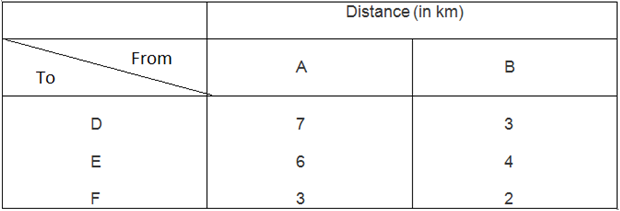
An oil company has two depots$, A$ and $B,$ with capacities of $7000$ litres and $4000$ litres respectively. The company is to supply oil to three petrol pumps, $\text{D, E, F}$ whose requirements are $4500, 3000$ and $3500$ litres respectively. The distance $($in $\ km)$ between the depots and petrol pumps is given in the following table:

Assuming that the transportation cost per km is $Rs. 1.00$ per litre, how should the delivery be scheduled in order that the transportation cost is minimum?
Find the length and the foot of the perpendicular drawn from the point $(2, –1, 5)$ to the line $\frac{\text{x - 11}}{10}=\frac{\text{y + 2}}{-4}=\frac{\text{z + 8}}{-11}.$
Find $\frac{\text{dy}}{\text{dx}}$
$\text{y}=\text{x}^{\sin\text{x}}+\big(\sin\text{x}\big)^\text{x}$