Question
Evaluate the following intregals:
$\int\frac{\text{x}^4}{(\text{x}-1)(\text{x}^2+1)}\ \text{dx}$

Answer

we have
$\text{I}=\int\frac{\text{x}^4\text{dx}}{(\text{x}-1)(\text{x}^2+1)}\ \text{dx}$
$=\int\Big[\frac{\text{x}^4-1+1}{(\text{x}-1)(\text{x}^2+1)}\Big]\text{dx}$
$=\int\frac{(\text{x}^4-1)\text{dx}}{(\text{x}-1)(\text{x}^2+1)}+\int\frac{\text{dx}}{(\text{x}-1)(\text{x}^2+1)}$
$=\int\frac{(\text{x}^2-1)(\text{x}^2+1)\text{ dx}}{(\text{x}-1)(\text{x}^2+1)}+\int\frac{\text{dx}}{(\text{x}-1)(\text{x}^2+1)}$
$=\int\frac{(\text{x}-1)(\text{x}-1)\text{ dx}}{(\text{x}-1)}+\frac{\text{dx}}{(\text{x}-1)(\text{x}^2+1)}$
$=\int(\text{x}+1)\ \text{dx}+\int\frac{\text{dx}}{(\text{x}-1)(\text{x}^2+1)}\ ...(1)$
Let $\frac{1}{(\text{x}-1)(\text{x}^2+1)}=\frac{\text{A}}{\text{x}+1}+\frac{\text{Bx}+\text{C}}{\text{x}^2+1}$
$\Rightarrow\frac{1}{(\text{x}-1)(\text{x}^2+1)}=\frac{\text{A}(\text{x}^2+1)+(\text{Bx}+\text{C})(\text{x}-1)}{(\text{x}-1)(\text{x}^2+1)}$
$\Rightarrow 1 = Ax^2 + A + Bx^2 - Bx + Cx - C$
$\Rightarrow 1 = (A + B)x^2 +(C - B)x + A - C$
Equating coefficient of like terms
A + B = 0 ...(1)
C - B = 0 ...(2)
A - C = 1 ...(3)
Solving (1), (2), (3) we get
$\text{B}=-\frac{1}{2},\text{A}=\frac{1}{2},\text{C}=-\frac{1}{2}$
$\therefore\frac{1}{(\text{x}-1)(\text{x}^2+1)}=\frac{1}{2(\text{x}-1)}+\frac{-\frac{\text{x}}{2}-\frac{1}{2}}{\text{x}^2+1}$
$\Rightarrow\frac{1}{(\text{x}-1)(\text{x}^2+1)}=\frac{1}{2(\text{x}-1)}-\frac{1}{2}\Big(\frac{\text{x}}{\text{x}^2+1}\Big)-\frac{1}{2(\text{x}^2+1)}\ ...(2)$
From (1) and (2)
$\text{I}=\int(\text{x}+1)\ \text{dx}+\frac{1}{2}\int\frac{\text{dx}}{\text{x}-1}-\frac{1}{2}\int\frac{\text{x dx}}{\text{x}^2+1}-\frac{1}{2}\int\frac{\text{dx}}{\text{x}^2+1}$
Putting $\text{x}^2+1=\text{t}$
$\Rightarrow2\text{x dx}=\text{dt}$
$\Rightarrow\text{x dx}=\frac{\text{dt}}{2}$
$\therefore\text{I}=\int(\text{x}+1)\ \text{dx}+\frac{1}{2}\int\frac{\text{dx}}{\text{x}-1}-\frac{1}{4}\int\frac{\text{dt}}{\text{t}}-\frac{1}{2}\int\frac{\text{dx}}{\text{x}^2+1}$
$=\frac{\text{x}^2}{2}+\text{x}+\frac{1}{2}\log|\text{x}-1|-\frac{1}{4}\log|\text{t}|-\frac{1}{2}\tan^{-1}\text{x}+\text{C}$

Need a full question paper?

Generate a complete, print-ready paper with questions like this in minutes — across 16+ boards, with answer keys.
Start Generating Free

Similar questions

Three bags contain a number of red and white balls as follows: Bag $1 : 3$ red balls, Bag $2 : 2$ red balls and $1$ white ball Bag $3 : 3$ white balls.
The probability that bag i will be chosen and a ball is selected from it is $\frac{\text{i}}{6}, i = 1, 2, 3$. What is the probability that:
  1. A red ball will be selected?
  2. A white ball is selected?
Verify the Rolle’s theorem for each of the functions:
$\text{f(x)}=\log(\text{x}^2+2)-\log3\text{ in }[-1,1].$
Differentiate the following functions with respect to x:
$\sqrt{\frac{1+\sin\text{x}}{1-\sin\text{x}}}$
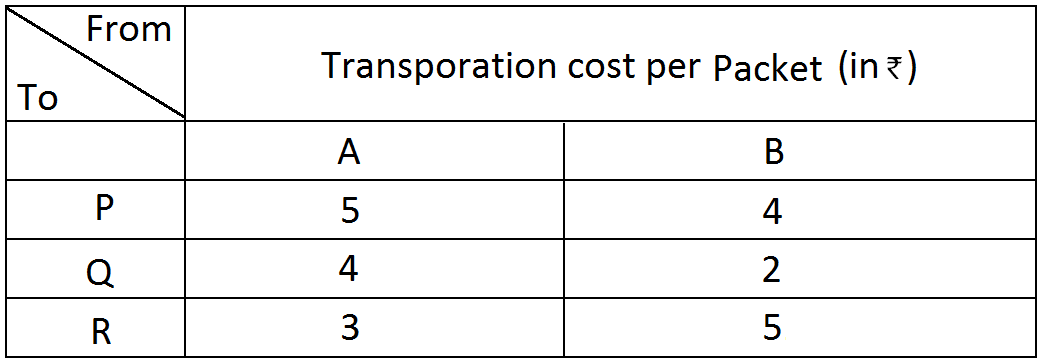
A medical company has factories at two places, A and B. From these places, supply is made to each of its three agencies situated at P, Q and R. The monthly requirements of the agencies are respectively 40, 40 and 50 packets of the medicines, while the production capacity of the factories, A and B, are 60 and 70 packets respectively. The transportation cost per packet from the factories to the agencies are given below:

How many packets from each factory be transported to each agency so that the cost of transportation is minimum? Also find the minimum cost?
Find a unit vector perpendicular to the plane A B C, where the coordinates of A, B and C are A (3, -1, 2), B (1, -1, -3) and C (4, -3, 1).
Find the equation of the plane passing through (a, b, c) and parallel to the plane $\vec{\text{r}}\cdot(\hat{\text{i}}+\hat{\text{j}}+\hat{\text{k}})=2.$
Find the values of a and b if the slope of the tangent to the curve xy + ax + by = 2 at (1, 1) is 2.
Evaluate the following integrals:
$\int\frac{\text{x}^2\sin^{-1}\text{x}}{(1-\text{x}^2)^{\frac{3}{2}}}\text{dx}$
Evaluate the following intregals:
$\int\frac{\text{x}+2}{\sqrt{\text{x}^2+2\text{x}-1}}\text{dx}$
Show that $\text{A}=\begin{bmatrix} 5 & 3 \\-1 & -2 \end{bmatrix}$ satisfies the equation $x^2 - 3x - 7 = 0$. Thus, find $A^{-1}.$