Question
Evaluate the following limit:
$\lim\limits_{\text{x}\rightarrow-2}\frac{\text{x}^3+\text{x}^2+4\text{x}+12}{\text{x}^3+3\text{x}+2}$

Answer

$\lim\limits_{\text{x}\rightarrow-2}\frac{\text{x}^3+\text{x}^2+4\text{x}+12}{\text{x}^3+3\text{x}+2}$
$=\lim\limits_{\text{x}\rightarrow-2}\frac{(\text{x}+2)\big(\text{x}^2+\text{x}+6\big)}{(\text{x}+2)\big(\text{x}^2-2\text{x}+1\big)}$
$=\lim\limits_{\text{x}\rightarrow-2}\frac{\text{x}^2+\text{x}+6}{\text{x}^2-2\text{x}+1}$
$=\frac{(-2)^2-(-2)+6}{(-2)^2-2(-2)+1}$
$=\frac{4+2+6}{4+4+1}$
$=\frac{12}{9}$
$=\frac{4}{3}$

Need a full question paper?

Generate a complete, print-ready paper with questions like this in minutes — across 16+ boards, with answer keys.

Start Generating Free

Similar questions

Differentiate the following from first principle: $\frac{1}{\sqrt{3-\text{x}}}$
Find the sum of the following geometric series:$(\text{x}+\text{y})+(\text{x}^2+\text{xy}+\text{y}^2)+(\text{x}^3+\text{x}^2\text{y}+\text{xy}^2+\text{y})+\ ...\text{ to n terms;}$
Find the mean deviation from the median for the following data:
Mark obtained
$10$
$11$
$12$
$14$
$15$
No. of students
$2$
$3$
$8$
$3$
$4$
Evaluate the following limit:
$\lim\limits_{\text{h}\rightarrow0}\frac{\text{(a}+\text{h})^2\sin(\text{a}+\text{h})-\text{a}^2\sin\text{a}}{\text{h}}$
Find the equation of the line passing through the point of intersection of the lines 4x - 7y - 3 = 0 and 2x - 3y + 1 = 0 that has equal intercepts on the axes.
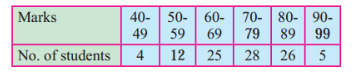
Given below is the frequency distribution of marks obtained by 100 students. Compute arithmetic mean and S.D.

Image

Tangents are drawn through a point $P$ to the ellipse $4 x^2+5 y^2=20$ having inclinations $\theta_1$and $\theta_2$ such that $\tan \theta_1+\tan \theta_2=2$. Find the equation of the locus of $P$.
The odds against student X solving a statistics problem are 8 : 6 and odds in favour of student Y solving the same problem are 14 : 16. Find the chance that : (i) the problem will be solved if they try it independently. 2. neither of them solves the problem.
If $\sin\text{x}=\frac{12}{13}$ and x lies in the second quadrant, find the value of $\sec\text{x}+\tan\text{x}.$
Evaluate the following limit:
$\lim\limits_{\text{x}\rightarrow0}\frac{\cos\text{ax}-\cos\text{bx}}{\cos\text{cx}-\cos\text{dx}}$