Question
Evaluate the following limit:
$\lim\limits_{\text{x}\rightarrow0}\frac{\sqrt{\text{a}^2+\text{x}^2}-\text{a}}{\text{x}^2}$

Answer

$\lim\limits_{\text{x}\rightarrow0}\frac{\sqrt{\text{a}^2+\text{x}^2}-\text{a}}{\text{x}^2}$
$=\lim\limits_{\text{x}\rightarrow0}\frac{\big(\sqrt{\text{a}^2+\text{x}^2}-\text{a}\big)}{\text{x}^2}\times\frac{\big(\sqrt{\text{a}^2+\text{x}^2}+\text{a}\big)}{\big(\sqrt{\text{a}^2+\text{x}^2}+\text{a}\big)}$
$=\lim\limits_{\text{x}\rightarrow0}\frac{\big(\text{a}^2+\text{x}^2-\text{a}^2\big)}{\text{x}^2\sqrt{\text{a}^2+\text{x}^2}+\text{a}}$
$=\lim\limits_{\text{x}\rightarrow0}\frac{\text{x}^2}{\text{x}^2\big(\sqrt{\text{a}^2+\text{x}^2}+\text{a}\big)}$
$=\lim\limits_{\text{x}\rightarrow0}\frac{1}{\sqrt{\text{a}^2+\text{x}^2+\text{a}}}$
$=\frac{1}{\text{a}+\text{a}}$
$=\frac{1}{2\text{a}}$

Need a full question paper?

Generate a complete, print-ready paper with questions like this in minutes — across 16+ boards, with answer keys.

Start Generating Free

Similar questions

Find the equation to the straight line parallel to 3x - 4y + 6 = 0 and passing through the middle point of the join of points (2, 3) and (4, -1).
Show that the plane $ax+ by+ cz + d = 0$ divides the line joining the points $(x_1, y_1, z_1)$ and $(x_2, y_2, z_2)$ in the ratio $=\frac{\text{ax}_1+\text{by}_1+\text{cz}_1+d}{\text{ax}_2+\text{by}_2+\text{cz}_2+d}.$
If $\text{a}=\frac{2\sin\text{x}}{1+\cos\text{x}+\sin\text{x}},$ then proved that $\frac{1-\cos\text{x}+\sin\text{x}}{1+\sin\text{x}}$ is also equal to a.
Find the equations of the straight lines passing through $(2, -1)$ and making an angle of $45^\circ $ with the line $6x + 5y - 8 = 0$.
If S, P, R are the sum, product, and sum of the reciprocals of n terms of a G.P, respectively,

then verify that $\left[\frac{S}{R}\right]^n= P ^2$.
The line through (h, 3) and (4, 1) intersects the line 7x - 9y - 19 = 0 at right angle. Find the value of h.
If $f, g$ and h are real functions defined by $\text{f(x)}=\sqrt{\text{x}+1},\text{ g(x)}=\frac{1}{\text{x}}$ and $h(x) = 2x^2 - 3,$ find the values of $(2f + g - h)(1)$ and $(2f + g - h) (0).$
Evaluate the following limit:
$\text{f(x)}=\frac{\text{ax}^2+\text{b}}{\text{x}^2+1},\lim\limits_{\text{x}\rightarrow0}\text{ f(x)}=1 $ and $\lim\limits_{\text{x}\rightarrow\infty}\text{f(x)}=1,$ then prove that $\text{f}(-2)=\text{f}(2)=1.$
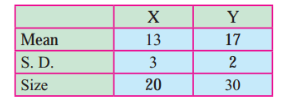
For certain data, the following information is available.

Image

Obtain the combined standard deviation.

How many triangles can be obtained by joining 12 points, five of which are collinear?