Question
Evaluate the following limit:
$\lim\limits_{\text{x}\rightarrow0}\frac{\sin(2+\text{x})-\sin(2-\text{x})}{\text{x}}$

Answer

$\lim\limits_{\text{x}\rightarrow0}\frac{\sin(2+\text{x})-\sin(2-\text{x})}{\text{x}}$
$=\lim\limits_{\text{x}\rightarrow0}2\cos\frac{\Big(\frac{{2+\text{x}+2-\text{x}}{2}}{\text{x}}\Big)\times\sin\Big(\frac{2+\text{x}-2+\text{x}}{2}\Big)}{{\text{x}}}$
$=2\lim\limits_{\text{x}\rightarrow0}\frac{\cos(2)\times\sin\text{x}}{\text{x}}$
$=2\lim\limits_{\text{x}\rightarrow0}\cos2\times\lim\limits_{\text{x}\rightarrow0}\frac{\sin\text{x}}{\text{x}}$ $\Big[\because\lim\limits_{\text{x}\rightarrow0}\frac{\sin\text{x}}{\text{x}}=1\Big]$
$=2\cos2\times1$
$=2\cos2$

Need a full question paper?

Generate a complete, print-ready paper with questions like this in minutes — across 16+ boards, with answer keys.
Start Generating Free

Similar questions

If $p^{th},$ qth and rth terms of an $A.P$. and $G.P$. are both $a, b,$ and $c$ respectively. Show that
$a^{b-c} \cdot b^{c-a} \cdot c^{a-b}=1$
Find the coordinates of the foci, the vertices, the length of major axis, the minor axis, the eccentricity and the length of the latus rectum of the ellipse.
$\frac{{{x^2}}}{4} + \frac{{{y^2}}}{{25}} = 1$
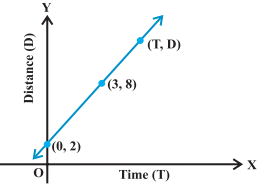
In Fig., time and distance graph of a linear motion is given. Two positions of time and distance are recorded as, when T = 0, D = 2 and when T = 3, D = 8. Using the concept of slope, find law of motion, i.e., how distance depends upon time.

Find the sum of n terms of the A.P. whose $k^{th}$ terms is $5k + 1.$
If the letters of the word ASSASSINATION are arranged at random. Find the Probability that:
All A’s are not coming together.
Find the equation of the line passing through $\Big(2,2\sqrt{3}\Big)$ and inclined with x-axis at an angle of $75^\circ .$
In a cricket team tournament 16 teams participated. A sum of ₹ 8000 is to be awarded among themselves as prize money. If the last place team is awarded ₹ 275 in prize money and the award increases by the same amount for successive finishing places, then how much amount will the first place team receive?
Solve the following linear inequations in R:
$\frac{3\text{x}-2}{5}\leq\frac{4\text{x}-3}{2}$
How many different numbers, greater than 50000 can be formed with the digits 0, 1, 1, 5, 9.
Evaluate the following one sided limits:
$\lim\limits_{\text{x}\rightarrow-2^+}\frac{\text{x}^2-1}{2\text{x}+4}$