Question
Evaluate the following limit:
$\lim\limits_{\text{x}\rightarrow{\frac{\pi}{4}}}\frac{\sqrt{2}-\cos\text{x}-\sin\text{x}}{(4\text{x}-\pi)^2}$
Answer

$\lim\limits_{\text{x}\rightarrow{\frac{\pi}{4}}}\frac{\sqrt{2}-\cos\text{x}-\sin\text{x}}{(4\text{x}-\pi)^2}$
$\text{x}\rightarrow\frac{\pi}{4}$ then $\text{x}-\frac\pi4\rightarrow0,$ also $4\text{x}-\pi\rightarrow0$ let $\text{x}-\frac{\pi}{4}\rightarrow\text{y}$
$=\lim\limits_{\text{x}-\frac{\pi}{4}\rightarrow{0}}\frac{\sqrt{2}-\cos\text{x}-\sin\text{x}}{(4)^2\big(\text{x}-\frac{\pi}{4}\big)^2}$
$=\lim\limits_{\text{y}\rightarrow{0}}\frac{\sqrt{2}-\cos\big({\text{y}+\frac\pi4\big)-\sin\big({\text{y}+\frac\pi4\big)}}}{16\times\text{y}^2}$
$=\frac{1}{16}\lim\limits_{\text{y}\rightarrow{0}}\frac{\sqrt{2}-\big(\cos\text{y}\times\frac{1}{\sqrt{2}}-\sin\text{y}\times\frac{1}{\sqrt{2}}\big)-\big(\frac{\sin\text{y}}{\sqrt{2}}+\frac{\cos\text{y}}{\sqrt{2}}\big)}{\text{y}^2}$
$=\frac{1}{16}\lim\limits_{\text{y}\rightarrow{0}}\frac{\sqrt{2}-\frac{1}{\sqrt{2}}(\cos\text{y}-\sin\text{y})-\frac{1}{\sqrt{2}}(\sin\text{y}+\cos\text{y})}{\text{y}^2}$
$=\frac{1}{16}\lim\limits_{\text{y}\rightarrow{0}}\frac{\sqrt{2}-\frac{1}{\sqrt{2}}\big[(\cos\text{y}-\sin\text{y})-(\sin\text{y}+\cos\text{y})\big]}{\text{y}^2}$
$=\frac{1}{16}\lim\limits_{\text{y}\rightarrow{0}}\frac{\Big(\sqrt{2}-\frac{1}{\sqrt{2}}\cos\text{y}+\frac{1}{\sqrt{2}}\sin\text{y}-\frac{1}{\sqrt{2}}\sin\text{y}-\frac{1}{\sqrt{2}}\cos\text{y}\Big)}{\text{y}^2}$
$=\frac{1}{16}\lim\limits_{\text{y}\rightarrow{0}}\frac{\sqrt{2}-\frac{1}{\sqrt{2}}\cos\text{y}}{\text{y}^2}$
$=\frac{\sqrt{2}}{16}\lim\limits_{\text{y}\rightarrow{0}}\frac{{2}\sin^2\frac{\text{y}}{{2}}}{\text{y}^2}$
$=\frac{\sqrt{2}}{8}\lim\limits_{\text{y}\rightarrow{0}}\Bigg(\frac{\sin\frac{\text{y}}{{2}}}{\frac{\text{y}}{2}}\Bigg)^2\times\frac14$
$=\frac{1}{16\sqrt{2}}$

Need a full question paper?

Generate a complete, print-ready paper with questions like this in minutes — across 16+ boards, with answer keys.

Start Generating Free

Similar questions

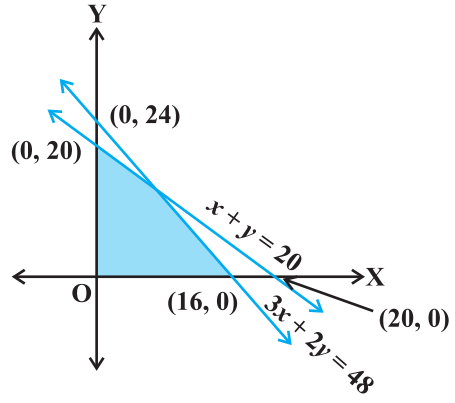
Find the linear inequalities for which the shaded region in the given figure is the solution set.
Evaluate the following limit:
$\lim\limits_{\text{x}\rightarrow{\frac{\pi}{2}}}\frac{1-\sin\text{x}}{\big(\frac{\pi}{2}-\text{x}\big)}$
In a single throw of two dice, find the probability that neither a doublet nor a total of 9 will appear.
Let A = {x : x $\in$ N}, B = {x : x = 2n, n $\in$ N}, C = {x : x = 2n - 1, n $\in$ N} and D = {x : x is a prime natural number}. Find:
$\text{B}\cap\text{C}$
Find the equation of the straight lines passing through the following pair of points:
(0, 0) and (2, -2)
The length of the perpendicular from the origin to a line is 7 and the line makes an angle of 150° with the positive direction of Y-axis. Find the equation of the line.
Match each item given under the column $C_1$ to its correct answer given under the column $C_2.$
There are $3$ books on Mathematics$, 4$ on Physics and $5$ on English. How many different collections can be made such that each collection consists of :
 
$C_1$
 
$C_2$
$(a)$
One book of each subject.
$(i)$ $3968$
$(b)$
At least one book of each subject.
$(ii)$ $60$
$(c)$
At least one book of English.
$(iii)$ $3255$
If $\tan69^\circ+\tan66^\circ-\tan69^\circ\tan66^\circ=2\text{k},$ then $k =$
Find the image of point $(2,3)$ w.r.t. line $x-2 y+$ $1 = 0$.
If the sum of an infinite decreasing $G.P.$ is $3$ and the sum of the squares of its term is $\frac{9}{2}$, then write its first term and common difference.