Question
Evaluate the following limit:
$\lim\limits_{\text{x}\rightarrow{\pi}}\frac{\sqrt{2+\cos\text{x}}-1}{({\pi-\text{x}})^2}$

Answer

$\lim\limits_{\text{x}\rightarrow{\pi}}\frac{\sqrt{2+\cos\text{x}}-1}{({\pi-\text{x}})^2}$
$=\lim\limits_{\text{x}\rightarrow{\pi}}\frac{\sqrt{2+\cos\text{x}}-1}{({\pi-\text{x}})^2}\times\frac{\sqrt{2+\cos\text{x}}+1}{{\sqrt{2+\cos\text{x}}+1}}$
$=\lim\limits_{\text{x}\rightarrow{\pi}}\frac{(2+\cos\text{x})-1}{(\pi-\text{x})^2\big(\sqrt{2+\cos\text{x}}+1\big)}$
$=\lim\limits_{\text{x}\rightarrow{\pi}}\frac{1+\cos\text{x}}{(\pi-\text{x})^2\big(\sqrt{2+\cos\text{x}}+1\big)}$
Let $\pi-\text{x}=\text{y},\text{x}\rightarrow\pi,\text{y}\rightarrow0$
$\Rightarrow\lim\limits_{\text{x}\rightarrow{\pi}}\frac{1+\cos\text{x}}{(\pi-\text{x})^2\big(\sqrt{2+\cos\text{x}}+1\big)}=\lim\limits_{\text{y}\rightarrow0}\frac{1+\cos\text{x}(\pi-\text{y})}{\text{y}^2\big(\sqrt{2+\cos(\pi-\text{y})+1}\big)}$
$=\lim\limits_{\text{y}\rightarrow0}\frac{1-\cos\text{y}}{\text{y}^2\sqrt{2-\cos\text{y}+1}}$
$=\lim\limits_{\text{y}\rightarrow0}\frac{\frac{2\sin^2\text{y}}{2}}{\text{y}^2\sqrt{2-\cos\text{y}}+1}$
$=2\lim\limits_{\text{y}\rightarrow0}\Bigg(\frac{\frac{\sin\text{y}}{2}}{\frac{\text{y}}{2}}\Bigg)^2\times\frac{1}{4}\frac{1}{\sqrt{2-\cos\text{y}}+1}$
$=2\times\Big(\lim\limits_{\text{y}\rightarrow0}\frac{\sin\text{y}}{2}\Big)^2\times\frac{1}{4}\frac{1}{\lim\limits_{\text{y}\rightarrow0}\sqrt{2-\cos\text{y}}+1}$
$=2\times1\times\frac{1}{4}\times\frac{1}{\sqrt{2-\cos\text{0}}+1}$
$=2\times1\times\frac{1}{4}\times\frac{1}{\sqrt{2-1}+1}$
$=2\times1\times\frac{1}{4}\times\frac{1}{{1}+1}$
$=2\times1\times\frac{1}{4}\times\frac{1}{{2}}$
$=\frac{1}{4}$

Need a full question paper?

Generate a complete, print-ready paper with questions like this in minutes — across 16+ boards, with answer keys.

Start Generating Free

Similar questions

Evaluate the following:
$2\text{x}^3+2\text{x}^2-7\text{x}+72,$ when $\text{x}=\frac{3-5\text{i}}{2}$
Let f and g be two real functions defined by $\text{f(x)}=\sqrt{\text{x}+1}$ and $\text{g(x)}=\sqrt{9-\text{x}^2}$ Then describe the following functions:
$\text{f}^2+7\text{f}$
The product of three numbers in G.P. is 216. If 2, 8, 6 be added to them, the results are in A.P. Find the numbers.
Find the center, eccentricity, foci and directrices of the hyperbola
$\text{x}^{2}-3\text{y}^{2}-2\text{x}=8.$
The mean and standard deviation of marks obtained by 50 students of a class in three subjects, mathematics, physics and chemistry are given below:
Subject
Mathematics
Physics
Chemistry
Mean
42
32
40.9
Standard
12
15
20
Deviation


Which of the three subjects shows the highest variability in marks and which shows the lowest?
A solution of 8% boric acid is to be diluted by adding a 2% boric acid solution to it. The resulting mixture is to be more than 4% but less than 6% boric acid. If we have 640 litres of the 8% solution, how many litres of the 2% solution will have to be added?
If a, b, c are in A.P. b, c, d are in G.P. and $\frac{1}{\text{c}},\frac{1}{\text{d}},\frac{1}{\text{e}}$ are in A.P., prove that a, c, e are in G.P.
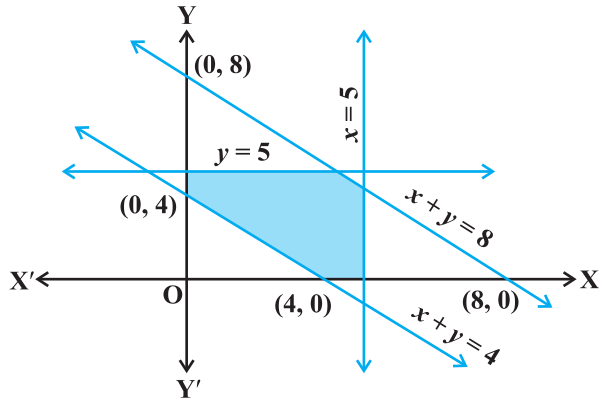
Find the linear inequalities for which the shaded region in the given figure is the solution set.
Evaluate the following limit:
$\lim\limits_{\text{x}\rightarrow0}\frac{\text{x}\tan\text{x}}{1-\cos2\text{x}}$
If $\sin\text{x}+\cos\text{x}=0$ and x lies in the fourth quadrant, find $\sin \text{x } $and $\cos\text{x}.$