Question
Evaluate the following limit:
$\lim\limits_{\text{x}\rightarrow{\frac{\pi}{2}}}\frac{\sqrt{2}-\sqrt{1+\sin\text{x}}}{\cos^2\text{x}}$

Answer

 $\lim\limits_{\text{x}\rightarrow{\frac{\pi}{2}}}\frac{\sqrt{2}-\sqrt{1+\sin\text{x}}}{\cos^2\text{x}}$

$=\lim\limits_{\text{x}\rightarrow{\frac{\pi}{2}}}\frac{\sqrt{2}-\sqrt{1+\sin\text{x}}}{\cos^2\text{x}}\frac{\sqrt{2}+\sqrt{1+\sin\text{x}}}{\sqrt{2}+\sqrt{1+\sin\text{x}}}$


$=\lim\limits_{\text{x}\rightarrow{\frac{\pi}{2}}}\frac{2-1-\sin\text{x}}{\cos^2\text{x}\big(\sqrt{2}-\sqrt{1+\sin\text{x}}\big)}$

$=\lim\limits_{\text{x}\rightarrow{\frac{\pi}{2}}}\frac{1-\sin\text{x}}{\big(1-\sin^2\text{x}\big)\big(\sqrt{2}-\sqrt{1+\sin\text{x}}\big)}$

$=\lim\limits_{\text{x}\rightarrow{\frac{\pi}{2}}}\frac{1}{\big(1+\sin\text{x}\big)\big(\sqrt{2}+\sqrt{1+\sin\text{x}}\big)}$

$=\frac{1}{(1+1)\big(\sqrt{2}+\sqrt{2}\big)}$

$=\frac{1}{\big(4\sqrt{2}\big)}$

Need a full question paper?

Generate a complete, print-ready paper with questions like this in minutes — across 16+ boards, with answer keys.

Start Generating Free

Similar questions

Prove that:
$\frac{\text{cosec}(90^{\circ}+\text{x})+\cot(450^\circ+\text{x})}{\text{cosec}(90^\circ-\text{x})+\tan(180^\circ-\text{x})}\\ +\frac{\tan\text{x}(180^\circ+\text{x})+\sec(180^\circ-\text{x})}{\tan(360^\circ+\text{x})-\sec(-\text{x})}=2$
Let A = {x : x $\in$ N}, B = {x : x = 2n,  n $\in$ N}, C = {x : x = 2n - 1, n $\in$ N} and D = {x : x is a prime natural number}. Find:
$\text{A}\cap\text{B}$

Find the coefficient of:

x-15 in the expansion of $\Big(3\text{x}^2-\frac{\text{a}}{3\text{x}^3}\Big)^{10}.$
How many word with or without meaning can be formed using all the letters of the word EQUATION at a time so that the vowels and consonants occur together?
If z and w are two complex numbers such that zw =1 and $\text{arg(z)}-\text{arg(w)}=\frac{\pi}{2},$ then show that $\bar{\text{z}}\text{w}=-\text{i}$
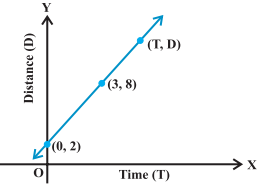
In Fig., time and distance graph of a linear motion is given. Two positions of time and distance are recorded as, when T = 0, D = 2 and when T = 3, D = 8. Using the concept of slope, find law of motion, i.e., how distance depends upon time.

If the straight line $\frac{\text{x}}{\text{a}}+\frac{\text{y}}{\text{b}}=1$ passes through the point of intersection of the lines x + y = 3 and 2x - 3y = 1 and is parallel to x - y - 6 = 0, find a and b.
Let A = {p, q, r, s} and B = {1, 2, 3}. Which of the following relations from A to B is not a function?
Find the domain and range of the function $f(x)=\frac{x^2-9}{x-3}$

Evaluate the following:

$(2+\sqrt3)^7+(2-\sqrt3)^7$