Question
Evaluate the following limits:

$\lim _{x \rightarrow 0}\left[\frac{\sqrt{1+x^2}-\sqrt{1+x}}{\sqrt{1+x^3}-\sqrt{1+x}}\right]$

Answer

Get the step-by-step solution for this question inside the Vidyadip app.

Get the answer in the app

Need a full question paper?

Generate a complete, print-ready paper with questions like this in minutes — across 16+ boards, with answer keys.

Start Generating Free

Similar questions

The vertices of a triangle are $A(1,4), B(2,3)$, and $C(1,6)$. Find equations of : altitudes of $\triangle A B C$
Find the variance and S.D. for the following set of numbers.
7, 11, 2, 4, 9, 6, 3, 7, 11, 2, 5, 8, 3, 6, 8, 8, 2, 6
800 people were asked whether they wear glasses for reading with the following results.
Age wear glasses do not wear glasses
≤30 310 90
>30 290 110
Compute the $ϰ^2$ square statistic.
A man gets a simple interest of $₹ 2,000$ on a certain principal at the rate of $5 \%$ p.a. in 4 years. What compound interest will the man get on twice the principal in 2 years at the same rate.
Evaluate the following limits:

$\lim _{x \rightarrow 2}\left[\frac{x^3-8}{\sqrt{x+2}-\sqrt{3 x-2}}\right]$
Following data gives height in cms (X) and weight in kgs (Y) of 20 boys. Prepare a bivariate frequency table taking class intervals 150 – 154, 155 – 159,…etc. for X and 35 – 39, 40 – 44,…, etc for Y. Also, find
(i) Marginal frequency distributions.
(ii) Conditional frequency distribution of Y when 155 ≤ X ≤ 159.
(152,40) (160,54) (163,52) (150,35) (154,36) (160,49) (166,54) (157,38)
(159,43) (153,48) (152,41) (158,51) (155,44) (156,47) (156,43) (166,53)
(160,50) (151,39) (153,50) (158,46)
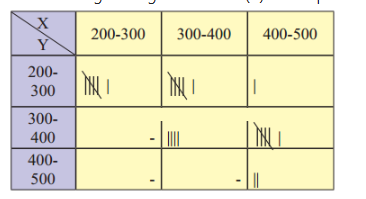
The following table gives income (X) and expenditure (Y) of 25 families:

Image

Find
(i) Marginal frequency distributions of income and expenditure.
(ii) Conditional frequency distribution of X when Y is between 300 – 400.
(iii) Conditional frequency distribution of Y when X is between 200 – 300.
(iv) How many families have their income ₹ 300 and more and expenses ₹ 400 and less?

Solve the following equations for $x, y \in R$ : $\frac{x+i y}{2+3 i}=7- i$
Solve the following linear equations by Cramer’s Rule.

(iii) x – y + 2z = 7, 3x + 4y – 5z = 5, 2x – y + 3z = 12

If $\mathrm{S}_1, \mathrm{~S}_2$, and $\mathrm{S}_3$ are the sums of first $\mathrm{n}$ natural numbers, their squares, and their cubes respectively, then show that:
$
9 S_2^2=\mathrm{S}_3\left(1+8 \mathrm{~S}_1\right)
$