Question
Evaluate the following limits:

$\lim _{x \rightarrow 2}\left[\frac{\sqrt{2+x}-\sqrt{6-x}}{\sqrt{x}-\sqrt{2}}\right]$

Answer

Get the step-by-step solution for this question inside the Vidyadip app.

Get the answer in the app

Need a full question paper?

Generate a complete, print-ready paper with questions like this in minutes — across 16+ boards, with answer keys.

Start Generating Free

Similar questions

In the following data, one of the values of y is missing. Arithmetic means of x and y series are 6 and 8 respectively. (√2 = 1.4142)

X

6

2

10

4

8

Y

9

11

?

8

7

(i) Estimate missing observation.
(ii) Calculate correlation coefficient.

If $x=a+b, y=\alpha a+\beta b$ and $z=a \beta+b \alpha$, where $\alpha$ and $\beta$ are the complex cube roots of unity, show that $x y z=a^3+b^3$.
Varun invested $25 \%, 30 \%$, and $20 \%$ of his savings in buying shares of three different companies, 'A', ' $\mathrm{B}$ ', and ' $\mathrm{C}$ ' which declared dividends, $10 \%, 12 \%$, and $15 \%$ respectively. If his total income on account of dividends is ₹ $6,370 /-$, find the amount he invested in buying shares of company ' $B$ '.
Evaluate the following limits:

$\lim _{x \rightarrow a}\left[\frac{\sqrt{a+2 x}-\sqrt{3 x}}{\sqrt{3 a+x}-2 \sqrt{x}}\right]$
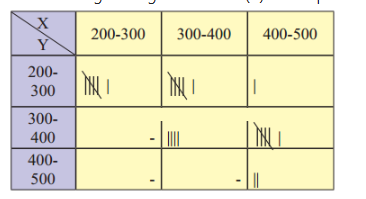
The following table gives income (X) and expenditure (Y) of 25 families:

Image

Find
(i) Marginal frequency distributions of income and expenditure.
(ii) Conditional frequency distribution of X when Y is between 300 – 400.
(iii) Conditional frequency distribution of Y when X is between 200 – 300.
(iv) How many families have their income ₹ 300 and more and expenses ₹ 400 and less?

Test the continuity of the following functions at the points indicated against them. $f(x)=\frac{x^3-27}{x^2-9}$ for $0 \leq x<3$ $=\frac{9}{2}$, for $3 \leq x \leq 6$, at $x=3$
Find a and b if following functions are continuous at the point indicated against them.

$
\begin{aligned}
& f(x)=\frac{32^x-1}{8^x-1}+a, \text { for } x>0 \\
& =2, \text { for } x=0 \\
& =x+5-2 b, \text { for } x<0
\end{aligned}
$
is continuous at $x=0$

Find Skb for the following set of observations:
18, 27, 10, 25, 31, 13, 28
In a group of students, there are 3 boys and 4 girls. Four students are to be selected at random from the group. Find the probability that either 3 boys and 1 girl or 3 girls and 1 boy are selected.
If $\mathrm{S}_1, \mathrm{~S}_2$, and $\mathrm{S}_3$ are the sums of first $\mathrm{n}$ natural numbers, their squares, and their cubes respectively, then show that:
$
9 S_2^2=\mathrm{S}_3\left(1+8 \mathrm{~S}_1\right)
$