Question
Evaluate the following:

$\sum_\limits{\text{n}=2}^{10}(4^\text{n})$

Answer

$\sum_\limits{\text{n}=2}^{10}(4^\text{n})$
$=4^2+4^3+4^4+\ \dots\ +4^{10}$
$\text{a}=4^2,\text{r}=\frac{4^3}{4}=4,\text{n}=9$
$\text{S}_{10}=\frac{\text{a}(\text{r}^9-1)}{1-\text{r}}$
$=\frac{4^2(4^9-1)}{4-1}$
$=\frac13\big[4^{11}-16\big]$
$=\frac{16}{3}\big[4^{9}-1\big]$

Need a full question paper?

Generate a complete, print-ready paper with questions like this in minutes — across 16+ boards, with answer keys.
Start Generating Free

Similar questions

Find the locus of a point such that the line segments having end points (2, 0) and (-2, 0) subtend a right angle at that point.
An arc is in the form of a parabola with its axis vertical. The arch is 10 m high and 5 m wide at the base. How wide is it 2 m from the vertex of the parabola?
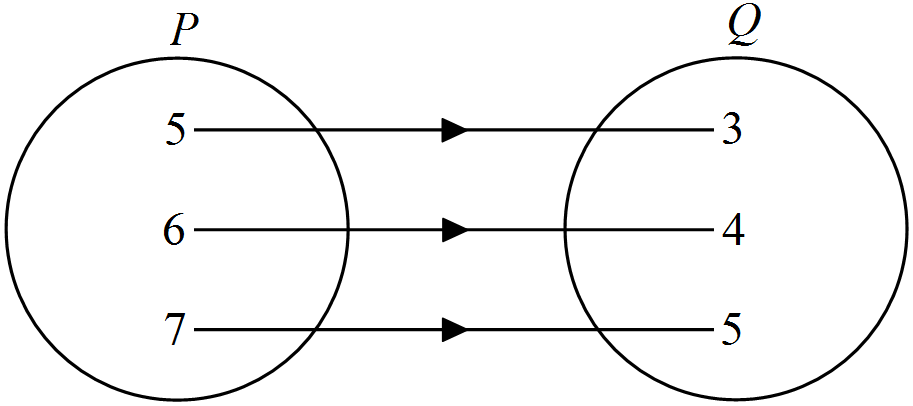
The adjacent figure shows a relationship between the sets P and Q. Write this relation in:

  1. Set builder form.
  2. Roster form. What is its domain and range?

For a G.P., if $(m+n)^{\text {th }}$ term is $P$ and $(m-n)$ th term is $q$, then prove that $m^{\text {th }}$ and $q^{\text {th }}$ term are $\sqrt{p q}$ and $p\left(\frac{q}{p}\right)^{m / 2 n}$ respectively.
For any two sets A and B, show that the following statements are equevalent:
$\text{A}\subset\text{B}.$
Prove that the product of the lengths of the perpendiculars drawn from the points $\left( {\sqrt {{a^2} - {b^2}} ,0} \right)$ and $\left( { - \sqrt {{a^2} - {b^2}} ,0} \right)$ to the line $\frac{x}{a}\cos \theta + \frac{y}{b}\sin \theta = 1$ is b2.
There are 25 trees at equal distances of 5 metres in a line with a well, the distance of the well from the nearest tree being 10 metres. A gardener waters all the trees separately starting from the well and he returns to the well after watering each tree to get water for the next. Find the total distance the gardener will cover in order to water all the trees.
Find the modulus and argument of the complex number $\frac{{1 + 2i}}{{1 - 3i}}$.
Find the inverse relation R-1 in the following case:
R = {(1, 2), (1, 3), (2, 3), (3, 2), (5, 6)}
Find all pairs of consecutive odd positive integers both of which are smaller than 10 such that their sum is more than 11.