Question
Evaluate the following:$\sum_\limits{\text{k}=1}^{\text{n}}(2^\text{k}+3^{\text{k}-1})$

Answer

$\sum_\limits{\text{k}=1}^{\text{n}}(2^\text{k}+3^{\text{k}-1})$ $=(2+3^0)+(2^2+3)+(2^3+3^2)+\ \dots\ +(2^\text{n}+3^{{\text{n}-}1})$ $(2+2^2+2^3+\ \dots\ +2^{\text{n}})+(3^0+3^1+3^2+\ \dots\ +3^{\text{n}-1})$ $=\text{S}_\text{n}+\text{S}_\text{m}$ $\text{S}_\text{n}\Rightarrow\text{a}=2,\text{n}=\text{n},\text{r}=\frac{2^2}{2}=2$ $\text{S}_\text{n}=\frac{\text{a}(\text{r}^\text{n}-1)}{\text{r}-1}=\frac{2(2^\text{n}-1)}{2-1}=2(2^\text{n}-1)$ Also, $\text{S}_\text{m}=\text{S}_{\text{n}-1}$ $\text{a}=1,\text{r}=3,\text{n}=\text{n}-1$ $\text{S}_{\text{n}-1}=\frac{1(3^{\text{n}-1}-1)}{3-1}=\frac12(3^{\text{n}}-1)$ $\therefore\sum_\limits{\text{k}-1}^\text{n}(2^{\text{k}}+3^{\text{k}-1})=2(2^\text{n}-1)+\frac12(3^\text{n}-1)$ $=\frac12\big[2^{\text{n}+2}+3^\text{n}-4-1\big]$ $=\frac12\big[2^{\text{n}+2}+3^\text{n}-5\big]$

Need a full question paper?

Generate a complete, print-ready paper with questions like this in minutes — across 16+ boards, with answer keys.

Start Generating Free

Similar questions

Find the $20^{th}$ term and the sum of $20$ terms of the series: $2 × 4 + 4 × 6 + 6 × 8 + ....$
The ratio of the A.M. and G.M. of two positive numbers a and b is Show that $a : b = \left( \begin{array} { c } { m + \sqrt { m ^ { 2 } - n ^ { 2 } } } \end{array} \right) : \left( m - \sqrt { m ^ { 2 } - n ^ { 2 } } \right)$
Find the point to which the origin should be shifted after a translation of axes so that the following equations will have no first deree terms: $x^2 - 12x + 4 = 0$
There are 10 professors and 20 students out of whom a committee of 2 professors and 3 students is to be formed. Find the number of ways in which this can be done. Further find in how many of these committees:
  1. A particular professor is included.
  2. A particular student is included.
  3. A particular student is excluded.
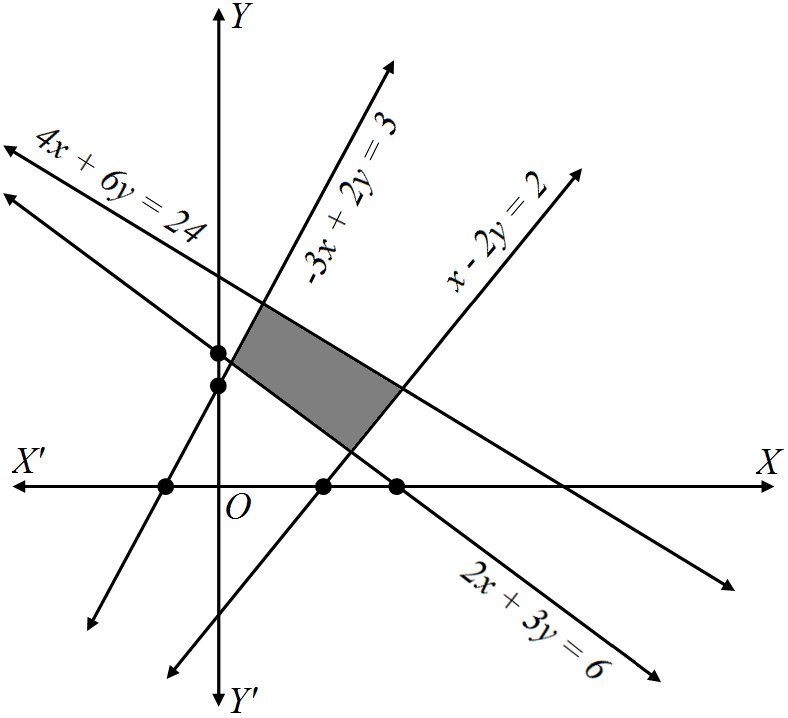
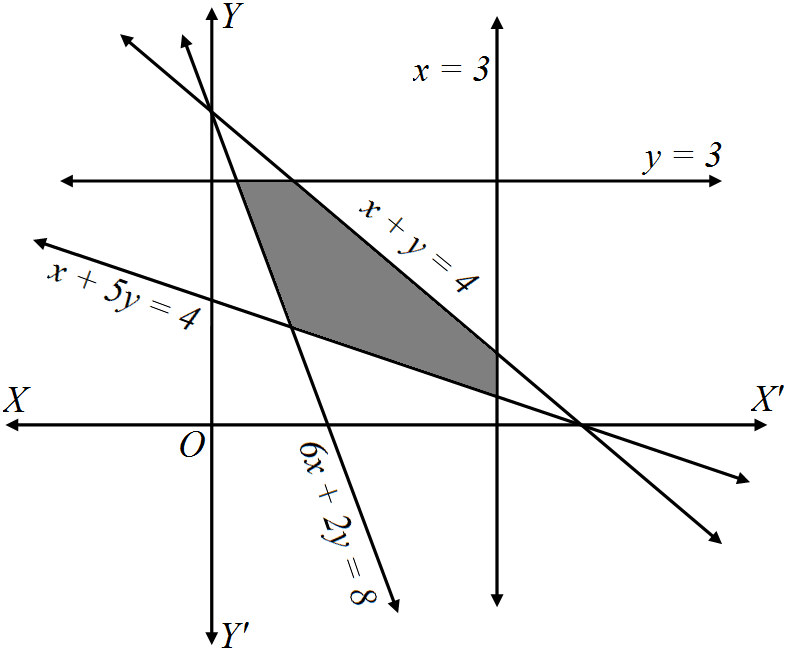
Find the linear inequations for which the shaded area in Fig. is the solution set. Draw the diagram of the solution set of the linear inequations:
Let f and g be two real functions defined by $\text{f(x)}=\sqrt{\text{x}+1}$ and $\text{g(x)}=\sqrt{9-\text{x}^2}$ Then describe the following functions: $\frac{5}{\text{g}}$
Represent to solution set of each of the following inequations graphically in two dimensional plane: $\text{x}+2\text{y}\geq6$
In a survey of 60 people, it was found that 25 people read newspaper H, 26 read newspaper T, 26 read newspaper I, 9 read both H and I, 11 read both H and T, 8 read both T and I, 3 read all three newspapers. Find: The number of people who read at least one of the newspapers.
A rod of length 12cm moves with its ends always touching the coordinate axes. Determine the equation of the locus of a point P on the rod, which is 3 cm from the end in contact with x-axis.
Find the number of combinations and permutations of 4 letters taken from the word 'EXAMINATION'.