Question
Evaluate the following:$9^4 \div 27^{-\frac{2}{3}}$

Answer

$9^4 \div 27^{-\frac{2}{3}} $
$=\left[(3)^2\right]^4 \div\left[(3)^3\right]^{-\frac{2}{3}}$
$ =(3)^{2 \times 4} \div(3)^{3 \times}\left(-\frac{2}{3}\right) \quad \ldots \ldots($ Using $\left(a^m\right)^n=a^{m n}) $
$=(3)^8 \div(3)-2$ 
$=(3)^{8-(-2)} \ldots . .($ Using  $a^m \div a^n=a^{m-n}) $
$ =(3)^{8+2} $
$ =3^{10}$
$ =(3)^{2 \times 5} $
$ =\left[(3)^2\right]^5$
$=[9]^5 $
$=59049 .$

Need a full question paper?

Generate a complete, print-ready paper with questions like this in minutes — across 16+ boards, with answer keys.
Start Generating Free

Similar questions

In a parallelogram $\text{PQRS}, M$ and $N$ are the midpoints of the opposite sides $PQ$ and $RS$ respectively. Prove that
$\text{PMRN}$ is a parallelogram.
If $m - n = 0.9$ and $mn = 0.36$, find:$m + n$
Solve the following systems of equations by using the method of cross multiplication:
2x - 5y + 8 = 0, x - 4y + 7 = 0
Find the perimeter of an equilateral triangle whose area is $16 \sqrt{3} \ cm$.
Ashok borrowed $Rs. 12,000$ at some rate on compound interest. After a year, he paid back $Rs.4,000$. If the compound interest for the second year is $Rs. 920,$ find:
  1. The rate of interest charged
  2. The amount of debt at the end of the second year
At what rate per cent per annum compound interest will ₹ 6250 amount to ₹ 7290 in 2 years?
A wire when bent in the form of a square encloses an area of $16 \ cm^2$. Find the area enclosed by it when the same wire is bent in the form of a rectangle whose sides are in the ratio of $1: 3$
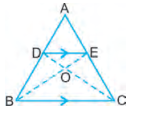
In the adjoining figure, $DE \| BC$.
Prove that: (i) ar $(\triangle ABE )=\operatorname{ar}(\triangle ACD )$.
(ii) $ar (\triangle OBD )=\operatorname{ar}(\triangle OCE )$.
Image
The difference between the simple interest and the compound interest on a sum of money for 3 years at 10% per annum is ₹ 558. Find the sum.
In parallelogram $\text{ABCD}, P$ is a point on side $AB$ and $Q$ is a point on side $BC$.Prove that:$(i) \triangle CPD$ and $\triangle AQD$ are equal in the area$.(ii)$ Area $(\triangle AQD) =$ Area$ (\triangle APD) +$ Area $(\triangle CPB)$