Question
Evaluate $\triangle=\begin{vmatrix}0&\sin\alpha&-\cos\alpha\\-\sin\alpha&0&\sin\beta\\\cos\alpha&-\sin\beta&0 \end{vmatrix}$

Answer

Let $\triangle=\begin{vmatrix}0&\sin\alpha&-\cos\alpha\\-\sin\alpha&0&\sin\beta\\\cos\alpha&-\sin\beta&0 \end{vmatrix}$
$\triangle=(-1)^{1+1}0(0+\sin^2\beta)+(-1)^{1+2}\sin\alpha(0-\sin\beta\cos)\beta\\+(-1)^{1+3}(-\cos\alpha)(\sin\alpha\sin\beta-0)$ [Expanding along R1]
$=0(0+\sin^2\beta)-\sin\alpha(0-\sin\beta\cos\alpha)-\cos\alpha(\sin\alpha\sin\beta-0)$
$=\sin\alpha\sin\beta\cos\alpha-\sin\alpha\sin\beta\cos\alpha$
$=0$

Need a full question paper?

Generate a complete, print-ready paper with questions like this in minutes — across 16+ boards, with answer keys.
Start Generating Free

Similar questions

Let * be a binary operation on Z defined by a * b = a + b - 4 for all a, b ∈ Z.
Show that '*' is both commutative and associative.
In $\left[\begin{array}{cc}x+y & 2 \\ 5+z & x y\end{array}\right]=\left[\begin{array}{ll}6 & 2 \\ 5 & 8\end{array}\right]$ find the value of $x, y, z$ ?
Show that the line through points (4, 7, 8) and (2, 3, 4) is parallel to the line throught the points (-1, -2, 1) and (1, 2, 5).
Find the coordinates of the point where the line through (5, 1, 6) and (3, 4, 1) crosses the:
zx-plane
For the following matrices verify the distributivity of matrix, multiplication over matrix addtion i.e., A(B + C) = AB + AC.
$\text{A}=\begin{bmatrix}1&-1\\0&2\end{bmatrix},\text{B}=\begin{bmatrix}-1&0\\2&1\end{bmatrix}$ and $\text{C}=\begin{bmatrix}0&1\\1&-1\end{bmatrix}$
Solve the following differential equation
$\text{x}\frac{\text{dy}}{\text{dx}}+\cot\text{y}=0$
Evaluate the following integrals:
$\int\Big(\frac{1}{\log\text{x}}-\frac{1}{(\log\text{x})^2}\Big)\text{dx}$
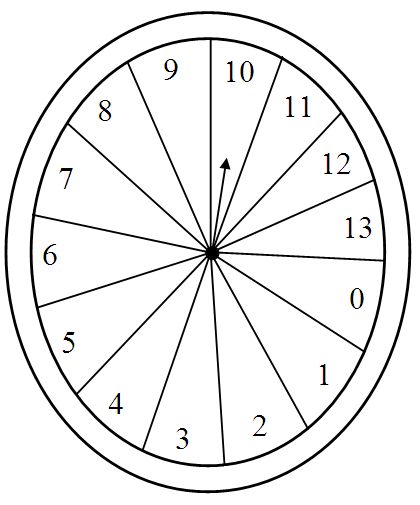
In roulette, Figure, the wheel has 13 numbers 0, 1, 2,...., 12 maked on equally spaced slots. A player sets Rs 10 on a given number. He recieves Rs 100 from the organiser of the game if the ball comes to rest in this slot; otherwise he gets nothing. If X denotes the players net gain/loss, Find E(X).

Solve the equation $\tan ^{-1}\left(\frac{1-x}{1+x}\right)=\frac{1}{2} \tan ^{-1} x, x>0$.
Find the area of the parallelogram whose diagonals are:
$2\hat{\text{i}}+\hat{\text{k}}$ and $\hat{\text{i}}+\hat{\text{j}}+\hat{\text{k}}$