Question
Evaluate:$\int\limits_{\pi/6}^{\pi/3}\frac{\sin\text{x}+\cos{\text{x}}}{\sqrt{\sin\text{2x}}}\text{dx}$ .

Answer

Let sin x – cos x = t $\Rightarrow$ (cos x + sin x) dx = dt, Also, sin 2x = 1 – t2
When $\text{x}\frac{\pi}{3},\text{t}=\frac{\sqrt{3}-1}{2},\text{when x}=\frac{\pi}{6},\text{t}=\frac{1-\sqrt{3}}{2}$
$\therefore$ Given integral becomes I = $\int^{\frac{\sqrt{3}-1}{2}}_{\frac{1-\sqrt{3}}{2}}\frac{\text{dt}}{\sqrt{1-\text{t}^{2}}}$
$[\sin^{-1}\text{t}]^{\frac{\sqrt{3}-1}{2}}_{\frac{1-\sqrt{3}}{2}}=\sin^{-1}\bigg(\frac{\sqrt{3}-1}{2}\bigg)-\sin^{-1}\bigg(\frac{1-\sqrt{3}}{2}\bigg)$
OR  $2\sin^{-1}\Bigg(\frac{\sqrt{3}-1}{2}\Bigg).$

Need a full question paper?

Generate a complete, print-ready paper with questions like this in minutes — across 16+ boards, with answer keys.
Start Generating Free

Similar questions

Evaluate the following integrals:
$\int\cos\Big\{2\cot^{-1}\sqrt{\frac{1+\text{x}}{1-\text{x}}}\Big\}\text{dx}$
If $\text{y}=\text{e}^{\text{x}^{\text{e}^\text{x}}}+\text{x}^{\text{e}^{\text{e}^\text{x}}}+\text{e}^{\text{x}^{\text{x}^{\text{e}}}},$ prove that $\frac{\text{dy}}{\text{dx}}=\text{e}^{\text{x}^{\text{e}^\text{x}}}\times\text{x}^{\text{e}^{\text{x}}}\Big\{\frac{\text{e}^\text{x}}{\text{x}}+\text{e}^\text{x}\log\text{x}\Big\}+\text{e}^{\text{x}^{\text{e}^{\text{x}}}}\times\text{e}^{\text{e}^\text{x}}\Big\{\frac{1}{\text{x}}+\text{e}^\text{x}\times\log\text{x}\Big\}+\text{e}^{\text{x}^{\text{x}^\text{e}}}\text{x}^{\text{x}^{\text{e}}}\times\text{x}^{\text{e}-1}\Big\{\text{x}+\text{e}\log\text{x}\Big\}$
verify that $\text{y}=\text{-x}-1$ is a solution of the differential equation $(\text{y}-\text{x})\text{dy}-(\text{y}^2-\text{x}^2)\text{dx}=0.$
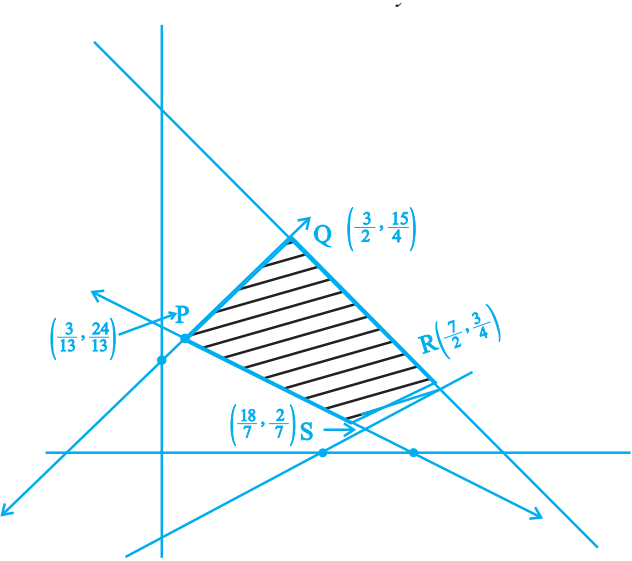
In the feasible region (shaded) for a LPP is shown. Determine the maximum and minimum value of Z = x + 2y.
Solve the following determinant equations:
$\begin{vmatrix}3&-2&\sin(3\theta)\\-7&8&\cos(2\theta)\\-11&14&2\end{vmatrix}=0$
Find the perpendicular distence of the point (1, 0, 0) from the line $\frac{\text{x}-1}{2}=\frac{\text{y}+1}{-3}=\frac{\text{z}+10}{8}.$ Also, find the coordinates of the perpendicular and the equation of the perpendicular.
If $A=\left[\begin{array}{ccc}2 & -3 & 5 \\ 3 & 2 & -4 \\ 1 & 1 & -2\end{array}\right]$ find $A^{-1}$, using $A^{-1}$ solve the system of equations
$2 x-3 y+5 z=11$
$3 x+2 y-4 z=-5$
$x+y-2 z=-3$
Verify Rolle's theorem of the following function on the indicated interval
$\text{f}(\text{x})=\frac{\text{x}}{2}-\sin\frac{\pi\text{x}}{6}\text{ on }[-1,0]$
Using integration, find the area of the region enclosed by the parabola y = 3x2 and the line 3x - y + 6 = 0.
A population grows at the rate of 5% per year. How long does it take for the population to double?