Question
Evalute the following integrals:
$\int\frac{2\cos\text{x}-3\sin\text{x}}{6\cos\text{x}+4\sin\text{x}}\text{dx}$

Answer

$\frac{2\cos\text{x}-3\sin\text{x}}{6\cos\text{x}+4\sin\text{x}}=\frac{2\cos\text{x}-3\sin\text{x}}{2(3\cos\text{x}+2\sin\text{x})}$
Let $3\cos\text{x}+2\sin\text{x}=\text{t}$
$(-3\sin\text{x}+2\cos\text{x})\text{dx}=\text{dt}$
$\int\frac{2\cos\text{x}-3\sin\text{x}}{6\cos\text{x}+4\sin\text{x}}\text{dx}=\int\frac{\text{dt}}{2\text{t}}$
$=\frac{1}{2}\int\frac{1}{\text{t}}\text{dt}$
$=\frac{1}{2}\log|\text{t}|+\text{C}$
$=\frac{1}{2}\log|2\sin\text{x}+3\cos\text{x}|=\text{C}$

Need a full question paper?

Generate a complete, print-ready paper with questions like this in minutes — across 16+ boards, with answer keys.
Start Generating Free

Similar questions

Evaluate the following integrals:
$\int\frac{\tan\text{x}}{\sec\text{x}+\tan\text{x}}\text{dx}$
If $\text{y}=\text{e}^\text{x}\cos\text{x},$ prove that $\frac{\text{d}^2\text{y}}{\text{dx}^2}=2\text{e}^\text{x}\cos(\text{x}+\frac{\pi}{2}).$
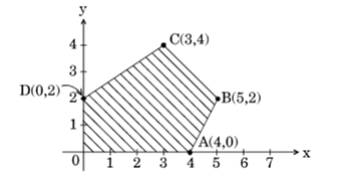
The corner points of the feasible region determined by the system of linear inequations are as shown below :
Image

Answer each of the following:
i. Let $z = 13x - 15y $ be the objective function. Find the maximum and minimum values of $z$ and also the
corresponding points at which the maximum and minimum values occur.
ii. Let $z = kx + y $ be the objective function. Find $k,$ if the value of $z$ at $A$ is same as the value of $z$ at $B$.
Suppose that $5\%$ of men and $0.25\%$ of women have grey hair. $A$ grey haired person is selected at random. What is the probability of this person being male? Assume that there are equal number of males and females.
Show that the line through points $(4, 7, 8)$ and $(2, 3, 4)$ is parallel to the line throught the points $(-1, -2, 1)$ and $(1, 2, 5).$
If f(x) = |x - 2| write whether f(2) exists or not.
Evalute the following integrals:
$\int\frac{\sin2\text{x}}{\sin\Big(\text{x}-\frac{\pi}{6}\Big)\sin\Big(\text{x}+\frac{\pi}{6}\Big)}\text{dx}$
Solve the following equation:$\cos(\tan^{-1}\text{x}) = \sin\bigg(\cot^{-1}\frac{3}{4}\bigg).$
If $\text{y}=\text{e}^\text{x}\cos\text{x},$ prove that $\frac{\text{d}^2\text{y}}{\text{dx}^2}=2\text{e}^\text{x}\cos(\text{x}+\frac{\pi}{2}).$
Evaluate the following integrals:
$\int\frac{1}{\text{x}^2}\cos^2\Big(\frac{1}{\text{x}}\Big)\text{dx}$