Question
Evalute the following integrals:
$\int\frac{\sin2\text{x}}{\text{a}^2+\text{b}^2\sin^2\text{x}}\text{dx}$

Answer

Let $\int\frac{\sin2\text{x}}{\text{a}^2+\text{b}^2\sin^2\text{x}}\text{dx}\ .....(\text{i})$
Let $\text{a}^2+\text{b}^2\sin^2\text{x}=\text{t}$ then,
$\text{d}\big(\text{a}^2+\text{b}^2\sin^2\text{x}\big)=\text{dt}$
$=\text{b}^2(2\sin\text{x}\cos\text{x})\text{dx}=\text{dt}$
$\Rightarrow\text{dx}=\frac{\text{dt}}{\text{b}^2(2\sin\text{x}\cos\text{x})}$
$=\frac{\text{dt}}{\text{b}^2\sin2\text{x}}$
Putting $\text{a}^2+\text{b}^2\sin^2\text{x}=\text{t}$ and $\text{dx}=\frac{\text{dt}}{\text{b}^2\sin2\text{x}}$ in equation (i), we get,
$\text{I}=\int\frac{\sin2\text{x}}{\text{t}}\times\frac{\text{dt}}{\text{b}^2\sin2\text{x}}$
$=\frac{1}{\text{b}^2}\int\frac{\text{dt}}{\text{t}}$
$=\frac{1}{\text{b}^2}\log|\text{t}|+\text{C}$
$=\frac{1}{\text{b}^2}\log|\text{a}^2+\text{b}^2\sin^2\text{x}|+\text{C}$
$\Rightarrow\text{I}=\frac{1}{\text{b}^2}\log|\text{a}^2+\text{b}^2\sin^2\text{x}|+\text{C}$

Need a full question paper?

Generate a complete, print-ready paper with questions like this in minutes — across 16+ boards, with answer keys.
Start Generating Free

Similar questions

If $\text{f(x)}=\begin{cases}\text{ax}^2-\text{b}, & \text{if |x|}<1\\\frac{1}{|\text{x}|}, & \text{if |x|}\geq1\end{cases}$ is differentiable at x = 1, find a, b.
A(1, 0, 4) B(0, -11, 1), C(2, -3, 1) are three points and D is the fool of perpendicular from A on BC. Find the coordinates of D.
Evaluate $\int_{\frac{-\pi}{4}}^{\frac{\pi}{4}} \sin ^2 x d x$.
In a hospital, there are 20 kidney dialysis machines and that the chance of any one of them to be out of service during a day is 0.02. Determine the probability that exactly 3 machines will be out of service on the same day.
Differentiate the following functions with respect to x:
$\text{x}\sin2\text{x}+5^{\text{x}}+\text{k}^\text{k}+(\tan^2\text{x})^3$
If $\vec{\text{a}},\ \vec{\text{b}},\ \vec{\text{c}}$ are non-coplanar vectors, prove that the point having the following position vectors is collinear:$\vec{\text{a}},\ \vec{\text{b}},\ 3\vec{\text{a}}-2\vec{\text{b}}$
Find the general solution of the differential equation $\frac{\text{dy}}{\text{dx}} = \frac{\text{y}^{2}}{\text{xy - x}^{2}}.$
Without expanding, show that the values of the following determinant are zero:
$\begin{vmatrix}\sin\alpha&\cos\alpha&\cos(\alpha+\delta)\\\sin\beta&\cos\beta&\cos(\beta+\delta)\\\sin\gamma&\cos\gamma&\cos(\gamma+\delta)\end{vmatrix}$
If $\text{A}=\begin{bmatrix}0 & 1 & 1 \\ 1 & 0 & 1 \\ 1 & 1 & 0 \end{bmatrix},$ find $A^{-1}$​​​​​​​ and show that $\text{A}^{-1}=\frac{1}{2}(\text{A}^2-3\text{I}).$
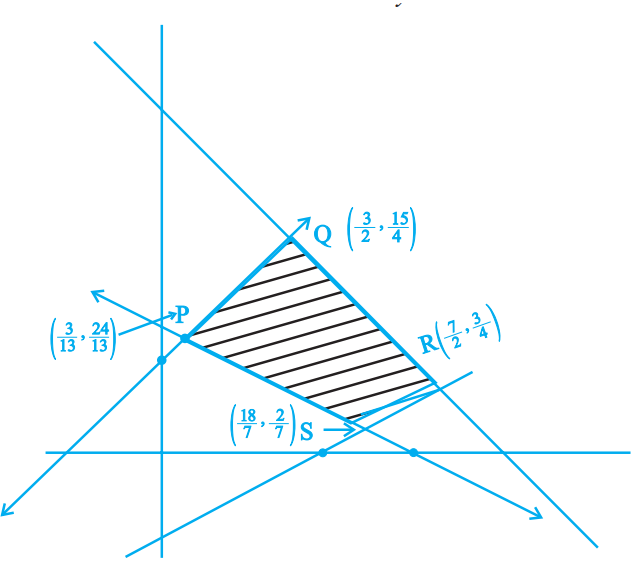
In the feasible region (shaded) for a LPP is shown. Determine the maximum and minimum value of Z = x + 2y.