Question
Evaluvate the following intregals:
$\int\frac{5\text{x}+3}{\sqrt{\text{x}^2+4\text{x}+10}}\ \text{dx}$

Answer

Let $\text{I}=\int\frac{5\text{x}+3}{\sqrt{\text{x}^2+4\text{x}+10}}\ \text{dx}$
Consider,
$5\text{x}+3=\text{A}\frac{\text{d}}{\text{dx}}(\text{x}^2+4\text{x}+10)+\text{B}$
$\Rightarrow5\text{x}+3=\text{A}(2\text{x}+4)+\text{B}$
$\Rightarrow5\text{x}+3=(2\text{A})\text{x}+4\text{A}+\text{B}$
Equating coefficient of like terms
$2\text{A}=5$
$\Rightarrow\text{A}=\frac{5}{2}$
And
$4\text{A}+\text{B}=3$
$\Rightarrow4\times\frac{5}{2}+\text{B}=3$
$\Rightarrow\text{B}=-7$
$\therefore\text{I}=\frac{5}{2}\int\frac{(2\text{x}+4)\text{dx}}{\sqrt{\text{x}^2+4\text{x}+10}}-7\int\frac{\text{dx}}{\sqrt{\text{x}^2+4\text{x}+10}}$
$=\frac{5}{2}\int\frac{(2\text{x}+4)\text{dx}}{\sqrt{\text{x}^2+4\text{x}+10}}-7\int\frac{\text{dx}}{\sqrt{\text{x}^2+4\text{x}+4-4+10}}$
$=\frac{5}{2}\int\frac{(2\text{x}+4)\text{dx}}{\sqrt{\text{x}^2+4\text{x}+10}}-7\int\frac{\text{dx}}{\sqrt{(\text{x}+2})^2+(\sqrt{6})^2}$
Putting, $\text{x}^2+4\text{x}+10=\text{t}$
$\Rightarrow(2\text{x}+4)\text{dx}=\text{dt}$
$\text{I}=\frac{5}{2}\int\frac{\text{dt}}{\sqrt{\text{t}}}-7\log\big|(\text{x}+2)^2+6\big|+\text{C}$
$=\frac{5}{2}\int\text{t}^{-\frac{1}{2}}\text{dt}-7\log\big|\text{x}+2+\sqrt{\text{x}^2+4\text{x}+10}\big|+\text{C}$
$=\frac{5}{2}\times2\sqrt{\text{t}}-7\log\big|\text{x}+2+\sqrt{\text{x}^2+4\text{x}+10}\big|+\text{C}$
$=5\sqrt{\text{x}^2+4\text{x}+10}-7\log\big|\text{x}+2+\sqrt{\text{x}^2+4\text{x}+10}\big|+\text{C}$

Need a full question paper?

Generate a complete, print-ready paper with questions like this in minutes — across 16+ boards, with answer keys.
Start Generating Free

Similar questions

Solve the following differential equation
$\sqrt{\text{a}+\text{x}}\text{dy}+\text{x dx}=0$
It is known that 60% of mice inoculated with a serum are protected from a certain disease. If 5 mice are inoculated, find the probability that.
  1. none contract the disease.
  2. more than 3 contract the disease.
$\int\frac{\text{x}-1}{\sqrt{\text{x}+4}}\ \text{dx}$
Show that the relation $R,$ defined on the set $A$ of all polygons as $R = (P_1, P_2): P_1$ and $P_2$ have same number of sides is an equivalence relation. What is the set of all elements in $A$ related to the right angle triangle $T$ with sides $3, 4$ and $5$?
Evaluate: $\int\limits^\frac{3}{2}_{0}|x \cos\pi x| dx$
Find the angle between the following pairs of lines:$\frac{\text{x}-1}{2}=\frac{\text{y}-2}{3}=\frac{\text{z}-3}{-3}$ and $\frac{\text{x}+3}{-1}=\frac{\text{y}-5}{8}=\frac{\text{z}-1}{4}$
Evaluate the following integrals:
$\int\limits_{0}^{{2\pi}}\sqrt{1-\sin\frac{\text{x}}{2}}\text{ dx}$
Show that the vectors $2\hat{\text{i}}-3\hat{\text{j}}+4\hat{\text{k}}$ and $-4\hat{\text{i}}+6\hat{\text{j}}-8\hat{\text{k}}$ are collinear.
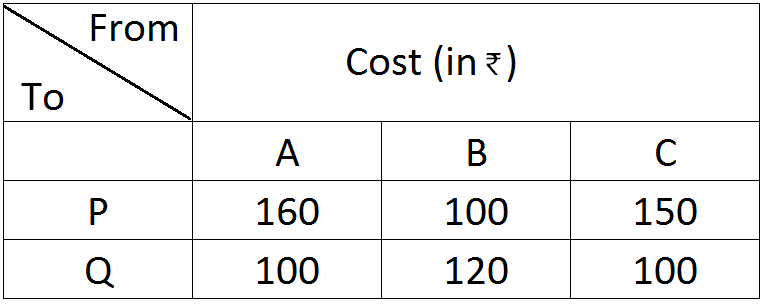
There are two factories located one at place P and the other at place Q. From these locations, a certain commodity is to be delivered to each of the three depots situated at A, B and C. The weekly requirements of the depots are respectively 5, 5 and 4 units of the commodity while the production capacity of the factories at P and Q are respectively 8 and 6 units. The cost of transportation per unit is given below:
How many units should be transported from each factory to each depot in order that the transportation cost is minimum. What will be the minimum transportation cost?
Find the particular solution of the differential equation $\log\Big(\frac{\text{dy}}{\text{dx}}\Big)= 3x + 4y,$ given that $y = 0$ when $x = 0.$