MCQ
Even Carnot engine cannot give $100\%$ efficiency because we cannot
  • A
    Prevent radiation
  • B
    Find ideal sources
  • Reach absolute zero temperature
  • D
    Eliminate friction

Answer

Correct option: C.
Reach absolute zero temperature
c
(c) The efficiency of Carnot engine is $\quad \eta=1-\frac{T_{2}}{T_{1}}$

where, $T_{1}$ is the temperature of the source and $T_{2}$ that

of sink. since, $\frac{T_{2}}{T_{1}}=\frac{Q_{2}}{Q_{1}}$

So, $\quad \eta=1-\frac{Q_{2}}{Q_{1}} |$

To obtain $100 \%$ efficiency (i.e., $\eta=1), Q_{2}$ must be zero i.e., if a sink at absolute zero would be available, all the heat taken from the source would have been converted into work. The temperature of sink means a negative temperature on the absolute scale at which the efficiency of engine is greater than unity. This would be a violation of the $2\, nd$ law of thermodynamics. Hence, a negative temperature on the absolute scale is impossible. Hence, we cannot reach absolute zero temperature.

Need a full question paper?

Generate a complete, print-ready paper with questions like this in minutes — across 16+ boards, with answer keys.
Start Generating Free

Similar questions

A gas at $NTP$ is suddenly compressed to one-fourth of its original volume. If $\gamma $ is supposed to be $\frac{3}{2}$, then the final pressure is........ atmosphere
A stone projected with a velocity u at an angle $\theta$ with the horizontal reaches maximum height $H_1$. When it is projected with velocity u at an angle $\left( {\frac{\pi }{2} - \theta } \right)$ with the horizontal, it reaches maximum height $ H_2$. The relation between the horizontal range R of the projectile, $H_1$ and $H_2$ is
Pressure applied to an enclosed fluid is transmitted undiminished to every portion of the fluid and the walls of the containing vessel. This law was first formulated by
Two resistors ${R}_{1}=(4 \pm 0.8) \Omega$ and ${R}_{2}=(4 \pm 0.4)$ $\Omega$ are connected in parallel. The equivalent resistance of their parallel combination will be
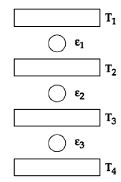
Three Carnot engines operate in series between a heat source at a temperature $T_1$ and a heat sink at temperature $T_4$ (see figure). There are two other reservoirs at temperature $T_2$ and $T_3$, as shown, with $T_1 > T_2 > T_3 > T_4$. The three engines are equally efficient if
A stone is dropped into a pond from the top of the tower of height $h$. If $v$ is the speed of sound in air, then the sound of splash will be heard at the top of the tower after a time
The angle of projection at which the horizontal range and maximum height of projectile are equal is
$N$ moles of an ideal diatomic gas are in a cylinder at temperature $T$. suppose on supplying heat to the gas, its temperature remain constant but $n$ moles get dissociated into atoms. Heat supplied to the gas is
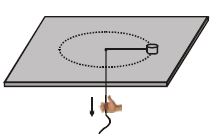
A small disk is attached to the end of a light inextensible string, which passes through a hole in a frictionless horizontal tabletop. Initially the disk moves on a circle of radius $R$ with kinetic energy $K_0$. The string is then slowly pulled so that the disk finally rotates on a circle of radius $\frac{R}{\eta }$. What is the work $W$ done in pulling the string
At $10^o C$ the value of the density of a fixed mass of an ideal gas divided by it pressure is $x.$ At  $110^o C$ this ratio is