Every atom makes one free electron in copper. If $1.1$ $ampere$ current is flowing in the wire of copper having $1\, mm$ diameter, then the drift velocity (approx.) will be (Density of copper $ = 9 \times {10^3}\,kg\,{m^{ - 3}}$ and atomic weight = $63$)
Diffcult
Download our app for free and get started
(b) Density of $Cu = 9 \times {10^3}\,kg/{m^3}$ (mass of $1$ $m^3$ of $Cu$)
( $6.0 \times 10^{23}$ atoms has a mass = $63 \times 10^{-3}\, kg$
Number of electrons per $m^3$ are
$ = \frac{{6.0 \times {{10}^{23}}}}{{63 \times {{10}^{ - 3}}}} \times 9 \times {10^3} = 8.5 \times {10^{28}}$
Now drift velocity $ = {v_d} = \frac{i}{{neA}}$
$ = \frac{{1.1}}{{8.5 \times {{10}^{28}} \times 1.6 \times {{10}^{ - 19}} \times \pi \times {{(0.5 \times {{10}^{ - 3}})}^2}}}$
$ = 0.1 \times {10^{ - 3}}\,m\,/sec$
( $6.0 \times 10^{23}$ atoms has a mass = $63 \times 10^{-3}\, kg$
Number of electrons per $m^3$ are
$ = \frac{{6.0 \times {{10}^{23}}}}{{63 \times {{10}^{ - 3}}}} \times 9 \times {10^3} = 8.5 \times {10^{28}}$
Now drift velocity $ = {v_d} = \frac{i}{{neA}}$
$ = \frac{{1.1}}{{8.5 \times {{10}^{28}} \times 1.6 \times {{10}^{ - 19}} \times \pi \times {{(0.5 \times {{10}^{ - 3}})}^2}}}$
$ = 0.1 \times {10^{ - 3}}\,m\,/sec$

Download our appand get started for free
Experience the future of education. Simply download our apps or reach out to us for more information. Let's shape the future of learning together!No signup needed.*
Similar Questions
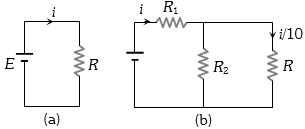
- 1Consider the circuits shown in the figure. Both the circuits are taking same current from battery but current through $R$ in the second circuit is $\frac{1}{{10}}$$^{th}$ of current through $R$ in the first circuit. If $R$ is $11$ $\Omega$, the value of $ R_1$ ................ $\Omega$View Solution
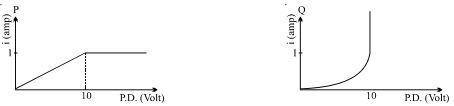
- 2Two current elements $P$ and $Q$ have current voltage characteristics as shown below :View Solution
Which of the graphs given below represents current voltage characteristics when $P$ and $Q$ are in series.
- 3An electric bulb rated for $500\, watts$ at $100\, volts$ is used in a circuit having a $200-volt$ supply. The resistance $R$ that must be put in series with the bulb, so that the bulb draws $500\, W$ is .................. $\Omega$View Solution
- 4If a copper wire is stretched to increase its length by $20 \% $. The percentage increase in resistance of the wire is $..........\%$View Solution
- 5If two bulbs of wattage $25$ and $100$ respectively each rated at $220\, volt$ are connected in series with the supply of $440\, volt$, then which bulbs will fuseView Solution
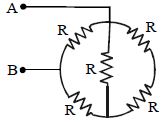
- 6The equivalent resistance between $A$ and $B$ isView Solution
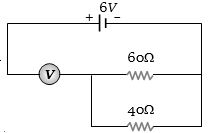
- 7The measurement of voltmeter in the following circuit is ................ $V$View Solution
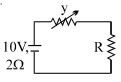
- 8In the figure shown the power generated in $y$ is maximum when $y = 5\,\Omega$ . Then $R$ is .............. $\Omega$View Solution
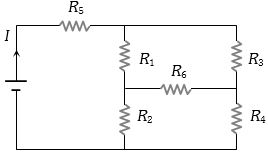
- 9In the given circuit, it is observed that the current $I$ is independent of the value of the resistance $R_6$. Then the resistance values must satisfyView Solution
- 10Three identical resistances $A$, $B$ and $C$ are connected as shown in the given figure. The heat produced will be maximumView Solution