MCQ
Every gas (real gas) behaves as an ideal gas
  • At high temperature and low pressure
  • B
    At low temperature and high pressure
  • C
    At normal temperature and pressure
  • D
    None of the above

Answer

Correct option: A.
At high temperature and low pressure
a
Real gas obeys vanderwaals equation

$\left( p +\frac{ n ^{2} a }{ V ^{2}}\right)( V - nb )= nRT$

at high temperature and low pressure

Van der waal equation becomes approximately $PV = nRT$

Hence gases behave ideally at high temperature and low pressure.

Need a full question paper?

Generate a complete, print-ready paper with questions like this in minutes — across 16+ boards, with answer keys.
Start Generating Free

Similar questions

A man of $60\,kg$ is running on the road and suddenly jumps into a stationary trolly car of mass $120\,kg$. Then. the trolly car starts moving with velocity $2\,ms ^{-1}$. The velocity of the running man was _________$ms ^{-1}$. when he jumps into the car
The amplitude of a particle executing $SHM$ is $4 \,cm$. At the mean position the speed of the particle is $16\, cm/sec$. The distance of the particle from the mean position at which the speed of the particle becomes $8\sqrt 3 \,cm/s,$ will be .... $cm$
An athlete completes one round of a circular track of radius $10\, m$ in $40\, sec$. The distance covered by him in $2 \,min$ $20 \,sec$ is ........ $m$
$A$ paritcle falls freely near the surface of the earth. Consider $a$ fixed point $O$ (not vertically below the particle) on the ground.
The force $F$ is given in terms of time $t$ and displacement $x$ by the equation $F = A\,cos\,Bx + C\,sin\,Dt.$ The dimensional formulae of $D/B$ is
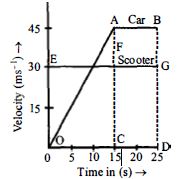
The velocity-time graphs of a car and a scooter are shown in the figure. $(i)$ the difference between the distance travelled by the car and the scooter in $15\, s$ and $(ii)$ the time at which the car will catch up with the scooter are, respectively
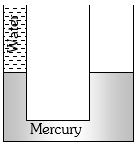
A $U-$ tube in which the cross-sectional area of the limb on the left is one quarter, the limb on the right contains mercury (density $13.6 g/cm^3$). The level of mercury in the narrow limb is at a distance of $36 cm$  from the upper end of the tube. What will be the rise in the level of mercury in the right limb if the left limb is filled to the top with water ........ $cm$
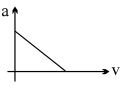
Acceleration versus velocity graph of a particle moving in a straight line starting from rest is as shown in figure. The corresponding velocity-time graph would be
The isothermal bulk modulus of a gas at atmospheric pressure is
Hairs of shaving brush cling together when it is removed from water due to