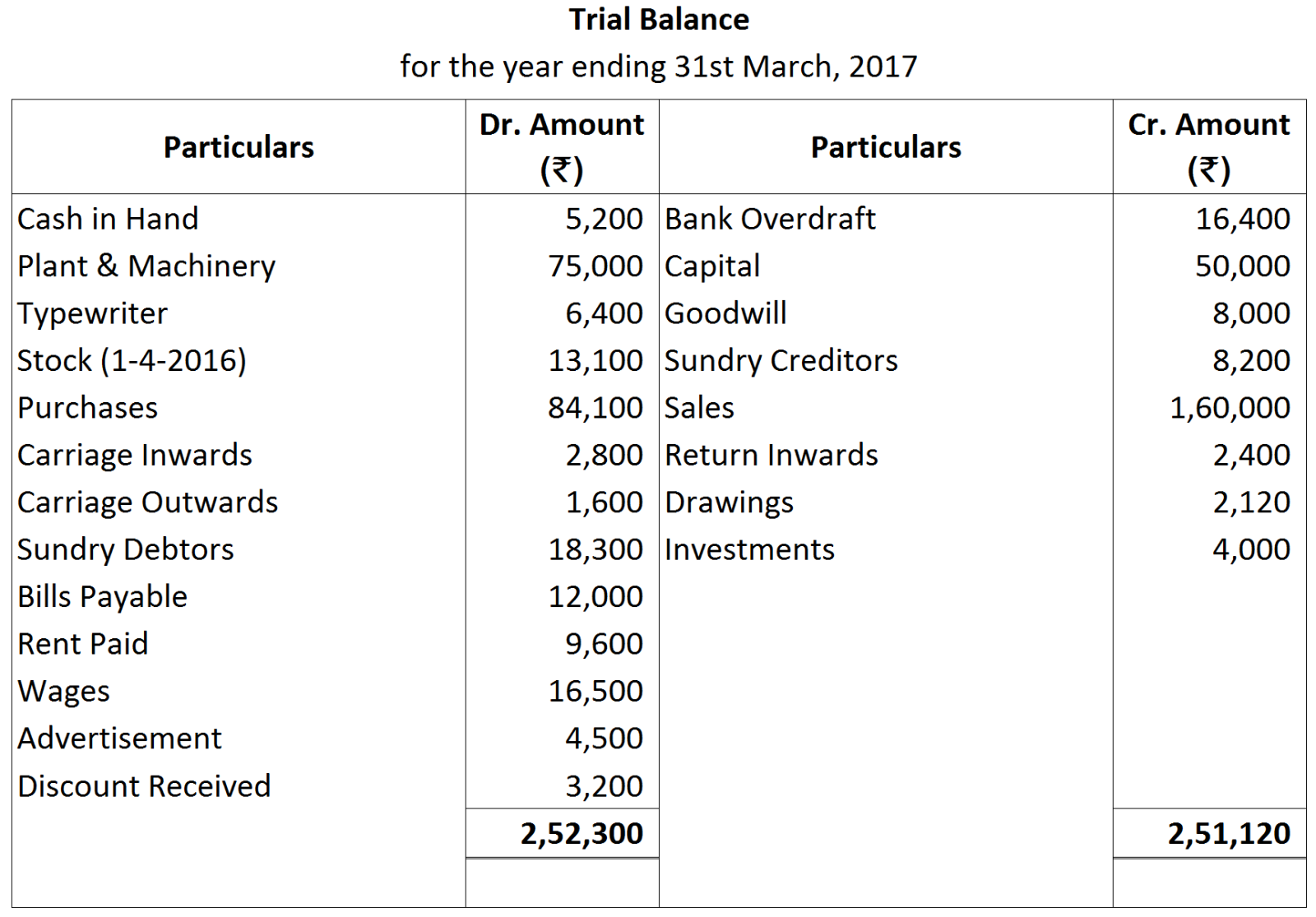
Question
“Every transaction has debit and credit aspects.” Explain.

Answer

According to this concept, every business transaction is recorded as having a dual aspect. In other words, every transaction affects atleast two accounts. If one account is debited, any other account must be credited. The system of recording transactions based on this principle is called as ‘Double Entry System'. It is because of this concept that the two sides of the Balance Sheet are always equal and the following accounting equations will always hold good at any point of time:
Assets = Liabilities + Capital
OR
Capital = Assets - Liabilities

Need a full question paper?

Generate a complete, print-ready paper with questions like this in minutes — across 16+ boards, with answer keys.

Start Generating Free

Similar questions

A sold goods for ₹ 40,000 to B on Jan. 01, 2017. He drew upon B a bill of exchange for the same amount payable after 1 month. B accepted the bill and sent it back to A. Adiscounted the bill immediately with his bank @ 9% p.a. On the due date B dishonoured the bill of exchange and the bank paid ₹ 200 as noting charges. B requested A to draw a new bill upon him with interest @ 12% p.a. which he agreed. The new bill was payable after 1 month. One week before the maturity of the second bill B requested A to cancel the second bill. He further requested to accept ₹ 15,000 in cash immediately and draw a third bill upon him including interest of ₹ 1,000. A agreed to B's request. The third bill was payable after one month. B met the third bill on its maturity. Record the necessary journal entries in the books of A and B and also prepare B's account in the books of Aand A's account in the books of B.
Pass entries for the following transactions in the books of M/s Karthikeyan & Co. of Chennai:
2019
 
June 10
Purchased goods from Ravichandran of Madurai of the list price of ₹ 2,00,000 at 25% trade discount at 4% cash discount on purchase price of goods. Paid CGST and SGST @ 9% each. Paid the entire amount by cheque on the same date.
June 25
Sold goods to Ramalingam of Erode of the list price of ₹ 3,75,000 at 20% trade discount and 2% cash discount on sale price. Charged CGST and SGST @ 9% each. Full amount was received by cheque on the same date.
Ignore adjustment and payment of GST.
Trial balance of Raju showed an excess debit of ₹ 10,000. He put the difference to suspense account and discovered the following errors:
  1. Depreciation written-off the furniture ₹ 6,000 was not posted to Furniture account.
  2. Credit sales to Rupam ₹ 10,000 were recorded as ₹ 7,000.
  3. Purchases book undercast by ₹ 2,000.
  4. Cash sales to Rana ₹ 5,000 were not posted.
  5. Old Machinery sold for ₹ 7,000 was credited to sales account.
  6. Discount received ₹ 800 from kanan on playing cash to him was not posted.
Rectify the errors and prepare suspense account.
On 31st January, 2017 the Pass Book of Shri M.L. Gupta shows a debit balance of ₹ 41,000. Prepare a bank reconciliation statement from the following particulars:-
  1. Cheques amounting to ₹ 15,600 were drawn on 27th January, 2017. Out of which cheques for ₹ 11,000 were encashed up to 31-1-2017.
  2. A wrong debit of ₹ 800 has been given by the bank in the Pass Book.
  3. A cheque for ₹ 200 was credited in the Pass Book but was not recorded in the Cash Book.
  4. Cheques amounting to ₹ 21,000 were deposited for collection. But out of these, cheques for ₹ 7,400 have been credited in the Pass Book on 5th February, 2017.
  5. A cheque for ₹ 1,000 was returned dishonoured by the bank and was debited in the Pass Book only.
  6. Interest on overdraft and bank charges amounting to ₹ 100 were not entered in the Cash Book.
  7. A cheque of ₹ 500 debited in the Cash Book omitted to be banked.
In taking out a Trial Balance, an Accountant finds an excess debit of ₹ 1,098. Being desirous of closing his books, he places the difference to Suspense A/c. Later on he detects the following errors:-
  1. Goods purchased from Surinder for ₹ 350 has been credited to his account as ₹ 530.
  2. Goods sold to Dinesh for ₹ 800 have been debited to his account as ₹ 880.
  3. A cheque of ₹ 1,250 received from a debtor had been correctly entered in the cash book but posted to his Personal A/c as ₹ 1,200.
  4. ₹ 780, paid for freight on machinery purchased was debited to Freight Account as ₹ 708.
  5. Goods to the value of ₹ 130 returned by a customer Navin Kumar had been posted to the debit of his account.
  6. ₹ 1,440 paid for repairs to Motor Car were debited to Motor Car A/c as ₹ 1,400.
  7. Total of purchase return book ₹ 500 was posted to the debit of Purchase A/c.
Give necessary rectifying entries and prepare suspense account.
The following is the Trial Balance prepared by an inexperienced accountant. Redraft it in a correct form and give necessary notes :-
During the course of an accounting year, the accountant prepared a trial balance which did not tally. He put the difference in a suspense account. Subsequently, he located the following errors in his books of account:
  1. The total of the returns outwards book, ₹ 21,500 has not been posted.
  2. A sale of ₹ 4,300 to Ramesh has been credited to him as ₹ 3,400.
  3. A sale of ₹ 2,960 to Shyam has been recorded in sales book as ₹ 2,690.
  4. Old furniture sold for cash worth ₹ 5,400 has been posted in sales account as ₹ 4,500. There was no profit or loss on sale.
  5. Goods taken by proprietor worth ₹ 1,000 have not been recorded in the books of account at all.
Pass journal entries of rectify the above mentioned errors and prepare suspense account assuming no error has remained undetected.
Prepare Bank Reconciliation Statement as on 30th September, 2016 from the following particulars:
 
 
(i)
Bank Balance as per Pass Book.
10,000
(ii)
Cheque deposited into bank but no entry was passed in Cash Book.
500
(iii)
Cheque received and entered in Cash Book but not sent to bank.
1,200
(iv)
Insurance premium paid directly by the bank.
800
(v)
Bank charges entered twice in the Cash Book.
20
(vi)
Cheque received entered twice in Cash Book.
1,000
(vii)
Bill discounted dishonoured not recorded in the cash book.
5,000
2017
 
March 1
Sold to Chandra Light House
50 Tubelights @ ₹ 60 each Less: 20%
20 Heaters @ ₹120 each Less: 25%
March 5
Purchased from Charat Ram Electric Co.
March 10
25 Table Fans @ ₹ 600 each
20 Ceiling Fans @ ₹800 each
Chaudhary & Sons purchased from us
80 Dozen Bulbs @ ₹ 90 per Dozen
March 12
Purchased from Ram Lal & Sons one Typewriter for ₹ 6,000 on credit, for office use.
March 16
Sri Ram & Sons sold to us:
10 Electric Irons @ ₹ 180 each less: 10%
March 20
Chandra Light House returned
March 22
5 Tubelights sold on March 1.
Sold goods to Jai Bhagwan & Co. for cash ₹ 10,000.
March 25
Returned to Sri Ram & Sons 2 Electric Irons purchased on March 16.
You are required to prepare:
  1. Purchase Book.
  2. Sales Book.
  3. Purchase Return Book.
  4. Sales Return Book.
A sells goods for ₹ 30,000 to B on 1st January, 2017 and on the same day draws a bill on B at three months for the amount. B accepts it and returns it to A, who discounts it on 4th February, 2017 with his bank at 18% per annum. The acceptance is dishonoured on the due date, the noting charges paid by the bank being ₹ 200.
On 4th April, 2017, B accepts a new bill at two months for the amount then due to Atogether with interest at 12 per cent per annum. Make Journal entries to record these transactions in the books of A and B.