MCQ
Evolution that shift the allele frequency in a study consistent direction is called?
- ✓Directional evolution
- BDisruptive evolution
- CMolecular evolution
- DAll of these
Selection process in natural selection are
$(i)$ Stabilizing Selection (Balancing selections) This type of selection favours average sized individuals, while eliminates small sized individuals. It reduces variation and hence, do not promote evolutionary changes. It maintains the mean value from generation to generation. If we draw a graphical curve of population, it is bell-shaped
$(ii)$ Directional Selection (Progressive Selection) In this selection, the population changes towards one particular direction. It means this type of selection favours small or large-sized individuals and more individuals of that type will be present in new generation. The mean size of the population changes
$(iii)$ Disruptive Selection (Diversifying selection) This type of selection favours both small-sized and large-sized individuals. It eliminates most of the members with mean expression, so as to produce two peaks in the distribution of the trait that may lead to the development of two different populations. This kind of selection is opposite of stabilizing selection and is rare nature but is very important in bringing about evolutionary changes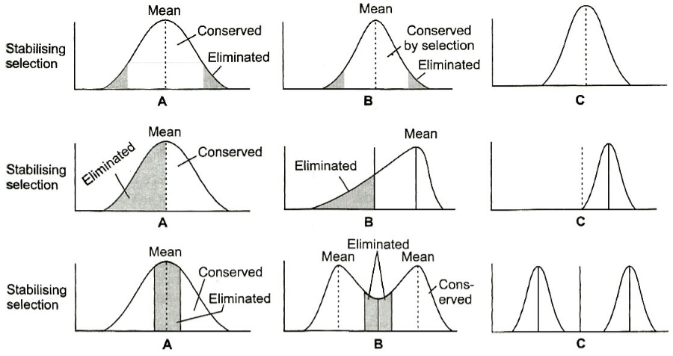
Generate a complete, print-ready paper with questions like this in minutes — across 16+ boards, with answer keys.
(column-$I$) with one characteristic
(column $II$), and the phylum/class
(column $III$) to which it belongs
Column $I$ - Column $II$ - Column $III$
| Column $ -I$ | Column $ -I$ |
| $A.$ Escherichia coli | $I.$ Nif gene |
| $B.$ Rhizobium melilotae | $II.$ Digestive hydrocarbon of crude oil |
| $C.$Bacillus thuringiensis | $III.$ Production of human insulin |
| $D.$Pseudomonas putida | $IV.$Biological control of fungal disease |
| $V.$ Biodecomposed insectiside |
| Swollen leaf base | - | Pulvinus |
| Lamina | - | Green expanded part of leaf |
| Trimerous | - | The floral appendages are in multiple of 5 |
| Rachis | - | Represents the midrib of the leaf |
Reason : Low oxygen concentration is provided by leghaemoglobin.