Question
✓
Answer
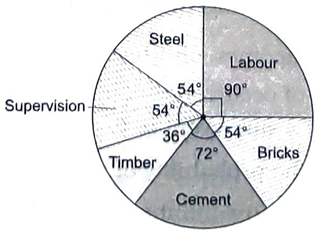
1. (c): Amount spent on timber = ₹ $\left(\frac{36}{360} \times 600000\right)$ = ₹ 60000.
2. (a): Amount spent on labour = ₹$\left(\frac{90}{360} \times 600000\right)$ = ₹ 150000.
Amount spent on supervision = ₹ $\left(\frac{54}{360} \times 600000\right)$ = ₹ 90000.
$\therefore \quad$ required difference = ₹$(150000-90000)$ = ₹ 60000.
3. (a): Required percentage = $=\left(\frac{72+54+54}{360} \times 100\right) \%=\left(\frac{180}{360} \times 100\right) \%=50 \%$.
4. (c): Required fraction = $\frac{72+54}{360}=\frac{126}{360}=\frac{7}{20}$.
2. (a): Amount spent on labour = ₹$\left(\frac{90}{360} \times 600000\right)$ = ₹ 150000.
Amount spent on supervision = ₹ $\left(\frac{54}{360} \times 600000\right)$ = ₹ 90000.
$\therefore \quad$ required difference = ₹$(150000-90000)$ = ₹ 60000.
3. (a): Required percentage = $=\left(\frac{72+54+54}{360} \times 100\right) \%=\left(\frac{180}{360} \times 100\right) \%=50 \%$.
4. (c): Required fraction = $\frac{72+54}{360}=\frac{126}{360}=\frac{7}{20}$.
Need a full question paper?
Generate a complete, print-ready paper with questions like this in minutes — across 16+ boards, with answer keys.
Explore more
Similar questions
Draw the front, side and top view of the given shapes.
In a right triangle $ABC, ÐB = 90^\circ $. If $AC = 13 \ cm, BC = 5 \ cm$, find $AB$
→Find the area of a rhombus whose side is $6\ cm$ and whose altitude is $4\ cm$. If one of its diagonals is $8\ cm$ long, find the length of the other diagonal.
→Name the property under multiplication used in the following: $\frac{-4}{5}\times1=1\times\frac{-4}{5}=-\frac{4}{5}$
→Find the square root of the following decimal numbers.$42.25$
→Find the square root of each of the following numbers by Division method.$576$
→Find the least number which must be subtracted from each of the following numbers so as to get a perfect square. Also find the square root of the perfect square so obtained.$825$
→Find the square root of each of the following numbers by Division method.$3481$
→Find the least number which must be added to each of the following numbers so as to get a perfect square. Also find the square root of the perfect square so obtained. $525$
→There are $m$ boys and $n$ girls in a class. Each boy donated twice as many rupees as is the total number of boys and each girl donated thrice as many rupees as is the total number of girls. The boys collected ₹1152 in all while the girls collected ₹768 in all.
(1) What is the value of $m$ ?
(a) 22$\quad$(b) 24$\quad$(c) 26$\quad$(d) 28
(2) What is the value of $n$ ?
(a) 12$\quad$(b) 14$\quad$(c) 16$\quad$(d) 18
(3) Had there been $(m+3)$ boys and $(n-3)$ girls in the class, the total amount collected would be
(a) ₹ 1925$\quad$(b) ₹ 1940(c) ₹ 1965$\quad$(d) ₹ 2000
(4) Let $p=m^2+n^2$. Then, which of the following is true for $p$ ?
(a) $p$ is a perfect square.(b) $(p+9)$ is a perfect square.(c) $(p+2)$ is a perfect square.(d) $(p-32)$ is a perfect square.
(5) Let $q=m^2-n^2$. Then, the least number to be added to $q$ to make it a perfect square is
(a) 4(b) 6(c) 8(d) 12
→(1) What is the value of $m$ ?
(a) 22$\quad$(b) 24$\quad$(c) 26$\quad$(d) 28
(2) What is the value of $n$ ?
(a) 12$\quad$(b) 14$\quad$(c) 16$\quad$(d) 18
(3) Had there been $(m+3)$ boys and $(n-3)$ girls in the class, the total amount collected would be
(a) ₹ 1925$\quad$(b) ₹ 1940(c) ₹ 1965$\quad$(d) ₹ 2000
(4) Let $p=m^2+n^2$. Then, which of the following is true for $p$ ?
(a) $p$ is a perfect square.(b) $(p+9)$ is a perfect square.(c) $(p+2)$ is a perfect square.(d) $(p-32)$ is a perfect square.
(5) Let $q=m^2-n^2$. Then, the least number to be added to $q$ to make it a perfect square is
(a) 4(b) 6(c) 8(d) 12