MCQ
Example of a three-dimensional silicate is
  • A
    Zeolites
  • B
    Ultramarines
  • Feldspars
  • D
    Beryls

Answer

Correct option: C.
Feldspars
c
The feldspars are most abundant aluminosilicate minerals in the Earth surface. The silicon atoms and aluminium atoms occupy the centres of interlinked tetrahedra of $SiO_4^{-4}$ and $AlO_4^{-5}$ . These tetrahedra connect at each corner to other tetrahedra forming an intricate, three dimesional, negatively charged framework. The sodium cations sit within the voids in this structure

Need a full question paper?

Generate a complete, print-ready paper with questions like this in minutes — across 16+ boards, with answer keys.

Start Generating Free

Similar questions

Addition of $OsO_4$ to cyclopentene would give a product which is
Which of the following species is planar
Assertion : The $O—O$ bond length in $H_2O_2$ is shorter than that of $O_2F_2$.
Reason : $H_2O_2$ is an ionic compound.
$25.3\ g$ of sodium carbonate, $Na_2CO_3$ is dissolved in enough water to make $250\ mL$ of solution. If sodium carbonate dissociates completely, molar concentration of sodium ion, $Na^+$ and carbonate ions, $CO_3^{2 - }$ are respectively

(Molar mass of $Na_2CO_3 = 106\ g\ mol^{-1} )$

The $IUPAC$ name of $\begin{matrix}
   C{{H}_{2}}-CH-C{{H}_{2}}-C{{H}_{2}}  \\
   |\,\,\,\,\,\,\,\,\,\,\,\,\,\,|\,\,\,\,\,\,\,\,\,\,\,\,\,\,\,\,\,\,\,\,\,\,\,\,\,\,\,\,\,\,\,\,\,\,\,\,|\,\,\,\,\,\,  \\
   N{{H}_{2}}\,\,\,\,C{{H}_{3}}\,\,\,\,\,\,\,\,\,\,\,\,\,\,\,\,\,\,\,\,\,\,\,\,\,\,\,N{{H}_{2}}  \\
\end{matrix}$ is
Arrange leaving power of $Nu^r$ group in decreasing order

$(I)$ $\begin{array}{*{20}{c}}
  {O\,\,\,\,\,\,\,\,\,\,\,\,\,\,\,\,\,\,\,\,} \\ 
  {||\,\,\,\,\,\,\,\,\,\,\,\,\,\,\,\,\,\,\,\,\,} \\ 
  {O - S - {C_6}{H_4} - C{H_3}} \\ 
  {||\,\,\,\,\,\,\,\,\,\,\,\,\,\,\,\,\,\,\,\,\,\,} \\ 
  {O\,\,\,\,\,\,\,\,\,\,\,\,\,\,\,\,\,\,\,\,\,\,} 
\end{array}\,$   $(II)$ $\begin{array}{*{20}{c}}  {O\,\,\,\,\,\,\,} \\   {||\,\,\,\,\,\,\,} \\   {O - S - {C_6}{H_5}} \\   {||\,\,\,\,\,\,\,} \\   {O\,\,\,\,\,\,\,} \end{array}\,$$(III)$ $N_3$ $(IV)$ $Br$
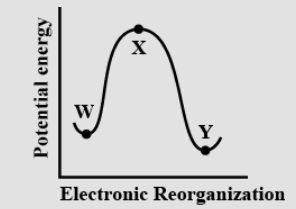
In the given potential energy diagram, the point X represents:

The number of moles of solute present in 1 kg of solvent is called:
What is the percent ionization $(\alpha)$ of a $0.01\, M\, HA$ solution ? .......$\%$ $(K_a = 10^{-6})$
$1$  mole of conc. $HCl $ requires $X$  moles of dilute $NaOH$  for neutralisation and $1$  mole of concentrate ${H_2}S{O_4}$ requires $Y$ moles of small dilute $NaOH$ then which of the following reaction is true