MCQ
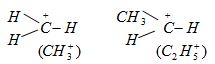
Example of $s{p^2}$ hybridization is
  • A
    $CH_3^ + $
  • B
    $C{H_3}$
  • C
    ${C_2}H_5^ + $
  • Both $(a)$ and $(c)$

Answer

Correct option: D.
Both $(a)$ and $(c)$
(d) Carbonium ions an $s{p^2}$ hybridized species.

Need a full question paper?

Generate a complete, print-ready paper with questions like this in minutes — across 16+ boards, with answer keys.
Start Generating Free

Similar questions

The compound $X\, (C_5H_8)$ reacts with ammonical $AgNO_3$ to give a white precipitate and reacts with excess of $KMnO_4$ to give the acid, $(CH_3)_2CH-COOH$, therefore $X$ is
According to dalton’s atomic theory, atoms of an element are
How will you separate a solution (miscible) of benzene $ + CHC{l_3}$
Lactic acid shows which type of isomerism
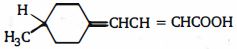
How many isomers are possible for the following molecule ?
In an experiment, $50\,mL$ of $0.1\,M$ solution of a metal salt reacted with $25\,mL$ of $0.1\,M$ solution of sodium sulphite. The half equation for the oxidation of sulphite ion is $S{O_3}^{2 - }\left( {aq} \right) + {H_2}O\left( l \right) \to S{O_4}^{2 - }\left( {aq} \right) + 2{H^ + }\left( {aq} \right) + 2{e^ - }$

If the oxidation number of metal in the salt was $3$, what would be the new oxidation number of metal ?
$Cl - C - Cl$ angle in $1, \,1, \,2, \,2 -$ tetrachloroethene and tetrachloromethane respectively are about
Which one of the following belongs to representative group of elements in the periodic table
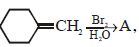
$A$ is
The $IUPAC$ name of 

$\begin{array}{*{20}{c}}
  {\,\,\,\,\,\,\,\,\,\,\,\,\,\,\,\,\,\,\,\,\,\,\,\,\,\,\,\,\,\,\,\,\,\,\,\,\,\,\,\,C{H_3}} \\ 
  {\,\,\,\,\,\,\,\,\,\,\,\,\,\,\,\,\,\,\,\,\,\,\,\,\,\,\,\,\,\,\,\,\,\,\,|} \\ 
  {C{H_3} - CH - C{H_2} - C - C{H_3}} \\ 
  {\,\,\,|\,\,\,\,\,\,\,\,\,\,\,\,\,\,\,\,\,\,\,\,\,\,\,\,\,\,\,\,\,\,\,\,|} \\ 
  {\,\,\,\,\,\,\,OH\,\,\,\,\,\,\,\,\,\,\,\,\,\,\,\,\,\,\,\,\,\,\,\,\,\,OH\,} 
\end{array}$ and $\begin{array}{*{20}{c}}
  {C{H_2} - CH - C{H_2}} \\ 
  {|\,\,\,\,\,\,\,\,\,\,\,\,\,\,|\,\,\,\,\,\,\,\,\,\,\,\,\,\,|\,\,\,\,\,} \\ 
  {CN\,\,\,\,\,\,\,\,CN\,\,\,\,\,\,\,\,CN\,\,} 
\end{array}$