MCQ
Examples of inorganic semiconductors is:
  • A
    Ge
  • CdS
  • C
    anthracene
  • D
    polyanilie

Answer

Correct option: B.
CdS
(b) - CdS

Need a full question paper?

Generate a complete, print-ready paper with questions like this in minutes — across 16+ boards, with answer keys.
Start Generating Free

Similar questions

The value of scattering angle of alpha particle for maximum value of impact parameter is :
In a npn transistor circuit, the collector current is 10mA. If 95 per cent of the electrons emitted reach the collector, which of the following statements are true?
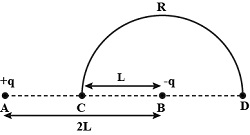
Charges $+q$ and $-q$ are placed at points $A$ and $B$ respectively which are a distance $2\,L$ apart, $C$ is  the midpoint between $A$ and $B.$ The work done in moving a charge $+Q$ along the semicircle $CRD$ is
An electron of mass $m$ and charge $q$ is travelling with a speed $v$ along a circular path of radius $r$ at right angles to a uniform of magnetic field $B$. If speed of the electron is doubled and the magnetic field is halved, then resulting path would have a radius of
A straight wire carrying current i is turned into a circular loop. If the magnitude of magnetic moment associated with it in M.K.S. unit is M, the length of wire will be
$O^{+++},C^+,He^{++}$ and $H^+$ ions are projected on the photographic plate with same velocity in a mass spectrograph. Which one will strike farthest 
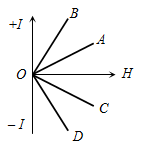
The variation of the intensity of magnetisation (I) with respect to the magnetising field (H) in a diamagnetic substance is described by the graph
An achromatic prism is made by crown glass prism $({A_c} = {19^o})$ and flint glass prism $({A_F} = {6^o})$. If $^C{\mu _v} = 1.5$ and $^F{\mu _v} = 1.66$, then resultant deviation for red coloured ray will be......$^o$
Ratio of amplitude of interfering waves is 3 : 4. Now ratio of their intensities will be
In saloons, there is always a characteristics smell due to the ammonia-based chemicals used in hair dyes and other products. Assume the initial concentration of ammonia molecules to be $1000 \,molecules/ m ^3$. Due to air ventilation, the number of molecules leaving in one minute is one tenth of the molecules present at the start of that minute. How long will it take for the concentration of ammonia molecules to reach $1 \,molecule / m ^3$ ?