MCQ
Experimentally it is found that $12.8\,eV$ energy is required to separate a hydrogen atom into a proton and an electron. So the orbital radius of the electron in a hydrogen atom is $\frac{9}{ x } \times 10^{-10}\,m$. The value of the $x$ is $\left(1\,eV =1.6 \times 10^{-19}\,J , \frac{1}{4 \pi \in_0}=9 \times 10^9\,Nm ^2 / C ^2\right.$ and electronic charge $=1.6 \times 10^{-19}\,J\,C$ )
  • A
    $15$
  • B
    $14$
  • $16$
  • D
    $13$

Answer

Correct option: C.
$16$
c
Binding energy of system $=\frac{k e^2}{2 r}$ joule and $\frac{k e^2}{2 r}=12.8\,ev$

$\frac{9 \times 10^9 \times\left(1.6 \times 10^{-19}\right)^2}{2 r}=12.8 \times 1.6 \times 10^{-19}$

$\Rightarrow r=\frac{9 \times 10^9 \times 1.6 \times 10^{-19}}{12.8 \times 2}$

$\Rightarrow r=\frac{9 \times 10^{-10}}{16}$

Need a full question paper?

Generate a complete, print-ready paper with questions like this in minutes — across 16+ boards, with answer keys.

Start Generating Free

Similar questions

A man balances himself in a horizontal position by pushing his hands and feet against two parallel walls. His centre of mass lies midway between the walls. The coefficients of friction at the walls are equal. Which of the following is not correct?
A sample of gas at temperature $\mathrm{T}$ is adiabatically expanded to double its volume. Adiabatic constant for the gas is $\gamma=3 / 2$. The work done by the gas in the process is : $(\mu=1 \mathrm{~mole})$
If $R =$ universal gas constant, the amount of heat needed to raise the temperature of $2$ mole of an ideal monoatomic gas from $273K$ to $373K$ when no work is done ...... $R$
A stone is dropped from a certain height which can reach the ground in $5\, second$. If the stone is stopped after $3\, second$ of its fall and then allowed to fall again, then the time taken by the stone to reach the ground for the remaining distance is........$sec$
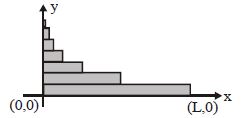
Infinite rods of uniform mass density and length $L, L/2, L/4....$ are placed one upon another upto infinite as shown in figure. Find the $x-$ coordinate of centre of mass
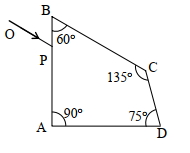
A ray $\mathrm{OP}$ of monochromatic light is incident on the face $\mathrm{AB}$ of prism $\mathrm{ABCD}$ near vertex $\mathrm{B}$ at an incident angle of $60^{\circ}$ (see figure). If the refractive index of the material of the prism is $\sqrt{3}$, which of the following is (are) correct? $Image$

$(A)$ The ray gets totally internally reflected at face $CD$

$(B)$ The ray comes out through face $\mathrm{AD}$

$(C)$ The angle between the incident ray and the emergent ray is $90^{\circ}$

$(D)$ The angle between the incident ray and the emergent ray is $120^{\circ}$

Thousand cells of same emf $E$ and same internal resistance $r$ are connected in series in same order without an external resistance. The potential drop across $399$ cells is found to be ......... $E$
A concave mirror has a focal length $20\,cm$. The distance between the two positions of the object for which the image size is double of the object size is......$cm$
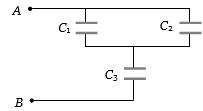
In the given network capacitance, ${C_1} = 10\,\mu \,F,\,{C_2} = 5\,\mu \,F$ and ${C_3} = 4\,\mu \,F$. What is the resultant capacitance between $A$ and $B$.......$\mu \,F$
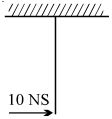
$A$ thin uniform straight rod of mass $2\, kg$ and length $1\, m$ is free to rotate about its upper end when at rest. It receives an impulsive blow of $10\, Ns$ at its lowest point, normal to its length as shown in figure. The kinetic energy of rod just after impact is ........ $J$