Question
Explain abnormal molar Tasses. Also explain association and dissociation of Solute.
Answer

$\rightarrow$ Ionic compounds when dissolved in water dissociate into cations and anions.
$\rightarrow$ For example, if we dissolve one mole of $KCI (74.5 \ g)$ in water, we expect one mole each of $K^+$ and $Cl^-$ions to be released in the solution. If this happens, there would be two moles of particles in the solution.
$\rightarrow$ one mole of $KCl$ in one $\ kg$ of water would be expected to increase the boiling point by $2 \times 0.52 \ K = 1.04 \ Κ$
$\rightarrow$ If we did not know about the degree of dissociation, we could be led to conclude that the mass of $2 \ mol$ particles is $74.5 \ g$ and the mass of one mole of $KCl$ would be $37.25 \ g.$
$\rightarrow$ When there is dissociation of solute into ions, the experimentally determined molar mass is always lower than the true value.
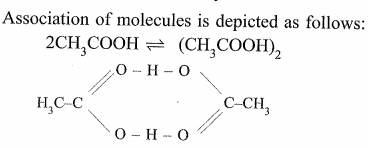
$\rightarrow$ Molecules of ethanoic acid (acetic acid) dimerise in benzene due to hydrogen bonding. This normally happens in solvents of low dielectric constant. In this case the number of particles is reduced due to dimerisation.
Image
$\rightarrow$ It can be undoubtedly stated here that if all the molecules of ethanoic acid associate in benzene, then $\Delta T _{ b }$ or $\Delta T _{ f }$ for ethanoic acid will be half of the normal value.
$\rightarrow$ The molar mass calculated on the basis of this $\Delta T_b$ or $\Delta T_f$ will, therefore, be twice the expected value. Such a molar mass that is either lower or higher than the expected or normal value is called as abnormal molar mass.

Need a full question paper?

Generate a complete, print-ready paper with questions like this in minutes — across 16+ boards, with answer keys.

Start Generating Free

Similar questions

Write the structures of A, B and C in the following:
  1. $\text{C}_{6}\text{H}_{5}-\text{CONH}_{2}\xrightarrow{Br_2/aq.KOH}A\xrightarrow[0-5^oC]{NaNO_2+Hcl}B\xrightarrow{KI}C$
  2. $\text{CH}_{3}-\text{Cl}\xrightarrow{KCN}A\xrightarrow{LiAlH_4}B\xrightarrow[\Delta]{CHCl_3+alc.KOH}C$
Explain vapour pressure of solutions of solids in liquids.
  1. State one use each of DDT and iodoform.
  2. Which compound in the following couples will react faster in $S_N2$ displacement and why?
  1. 1-Bromopentane or 2-bromopentane.
  2. 1-Bromo-2-methylbutane or 2-bromo-2-methylbutane.
State briefly the principles which serve as basis for the following operations in metallurgy:
  1. Froth floatation process.
  2. Zone refining.
  3. Refining by liquation.
A current of $1.50A$ was passed through an electrolytic cell containing $AgNO_3$ solution with inert electrodes. The weight of Ag deposited was $1.50g$. How long did the current flow?
Complete the following chemical equations:
  1. $\mathrm{Cr}_2 \mathrm{O}_7{ }^{2-}+6 \mathrm{Fe}^{2+}+14 \mathrm{H}^{+} \rightarrow$
  2. $2 \mathrm{CrO}_4^{2-}+2 \mathrm{H}^{+} \rightarrow$
  3. $2 \mathrm{MnO}_4^{-}+5 \mathrm{C}_2 \mathrm{O}_4{ }^{2-}+16 \mathrm{H}^{+} \rightarrow$
The following data were obtained during the first order thermal decomposition of $SO_2Cl_2$ at a constant volume:
$SO_2Cl_2(g) \rightarrow SO_2(g) + Cl_2(g)$
Experiment
Time/s$^{-1}$
Total pressure/atm
$1$
$2$
$0$
$100$
$0.4$
$0.7$
Calculate the rate constant.
$($Given$: \log 4 = 0.6021, \log  2 = 0.3010)$
What are the functions of hormones in body?
Tert$-$Butylbromide reacts with aq. $NaOH$ by $S_N1$ mechanism while $n-$butylbromide reacts by $SN_2$ mechanism. Why?
Assign reasons for the following:
  1. Phosphorus doped silicon is a semiconductor.
  2. Schottky defect lowers the density of a solid.
  3. Some of the very old glass objects appear slightly milky instead of being transparent.