Question
Explain ac voltage applied on a series LCR circuit and give its analytical solution.

Answer

SELF

Need a full question paper?

Generate a complete, print-ready paper with questions like this in minutes — across 16+ boards, with answer keys.

Start Generating Free

Similar questions

A rectangular loop of sides 20cm and 10cm carries a current of 5.0A. A uniform magnetic field of magnitude 0.20T exists parallel to the longer side of the loop.
  1. What is the force acting on the loop?
  2. What is the torque acting on the loop?
Three rods of lengths 20cm each and area of cross section $1cm^2$ are joined to form a triangle ABC. The conductivities of the rods are $\text{K}_\text{AB}=50\text{Js}^{-1}\text{m}^{-1}{^{\circ}}\text{C}^{-1},\ \text{K}_\text{BC}=200\text{Js}^{-1}\text{m}^{-1}{^{\circ}}\text{C}^{-1}$ and $\text{K}_\text{AC}=400\text{Js}^{-1}\text{m}^{-1}{^{\circ}\text{C}}^{-1}.$ The junctions A, B and C are maintained at $40^\circ C, 80^\circ C$ and $80^\circ C$ respectively. Find the rate of heat flowing through the rods AB, AC and BC.
An electric field is uniform, and in the positive $x$ direction for positive $x$, and uniform with the same magnitude but in the negative $x$ direction for negative $x$. It is given that $E =200 \hat{ i } N / C$ for $x>0$ and $E =-200 \hat{ i } N / C$ for $x<0$. A right circular cylinder of length $20 \ cm$ and radius $5 \ cm$ has its centre at the origin and its axis along the $x-$ axis so that one face is at $x=+10 \ cm$ and the other is at $x=-10 \ cm\  ($Fig. $1.25).\ (a)$ What is the net outward flux through each flat face? $(b)$ What is the flux through the side of the cylinder? $(c)$ What is the net outward flux through the cylinder? $(d)$ What is the net charge inside the cylinder?
The count rate of nuclear radiation coming from a radiation coming from a radioactive sample containing $^{128}I$ varies with time as follows.
Time t(minute): 0 25 50 75 100
Ctount rate $R(10^9s^{-1}):$ 30 16 8.0 3.8 2.0
  1. Plot In $\Big(\frac{\text{R}_0}{\text{R}}\Big)$ against t.
  2. From the slope of the best straight line through the points, find the decay constant $\lambda.$
  3. Calculate the half-life $\text{t}_{\frac{1}{2}}.$
A particle of mass 100g moving at an initial speed u collides with another particle of same mass kept initially at rest. If the total kinetic energy becomes 0.2J after the collision, what could be the minimum and the maximum value of u.
Assume that a tunnel is dug across the earth (radius = R) passing through its centre. Find the time a particle takes to cover the length of the tunnel if,
  1. It is projected into the tunnel with a speed of $\sqrt{\text{gR}}.$
  2. It is released from a height R above the tunnel.
  3. It is thrown vertically upward along the length of tunnel with a speed of $\sqrt{\text{gR}}.$
Explain the principle of superposition in terms of position vectors of charges.
Write the properties of charge. What is meant by charge conservation? Explain with example. What do you understand by charge quantization?
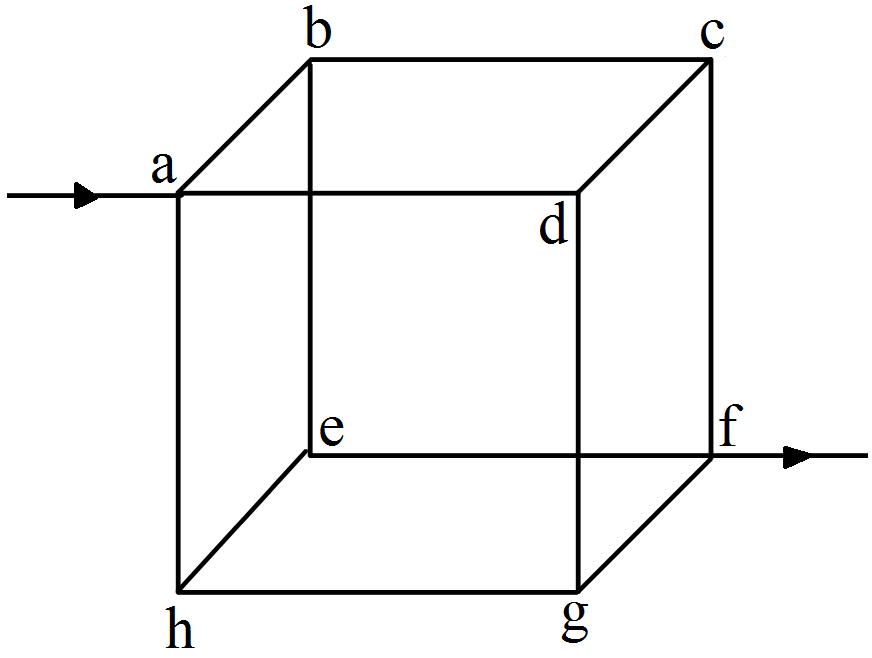
Twelve wires, each of equal resistance r, are joined to form a cube, as shown in the figure. Find the equivalent resistance between the diagonally opposite points a and f.
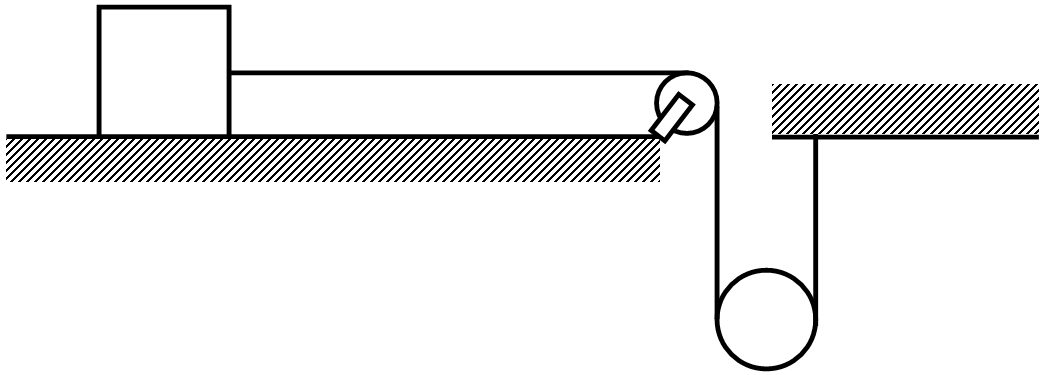
The descending pulley shown in figure has a radius 20cm and moment of inertia $0.20kg-m^2.$ The fixed pulley is light and the horizontal plane frictionless. Find the acceleration of the block if its mass is 1.0kg.